
Dividends are an excellent way to build regular passive income. To understand how this works, imagine you buy a company’s stock at a set price, and the company pays out a dividend. This gives you an initial dividend yield based on your purchase price. If the same company increases its payout in the future, your effective dividend yield rises accordingly. As the company continues to bump up its payouts, your yield goes up further.
Through this process, your dividends accumulate, causing your overall yield to compound. This growth relies heavily on two primary factors: the initial price you paid to lock in the stock, and the company’s ability to continuously distribute higher payouts over a long-term horizon.

Step-by-Step Guide to Screening Dividend Stocks

To systematically find high-quality dividend stocks, you can utilize stock screening tools to filter through thousands of public companies. Because stock prices and metrics change daily, focus on the criteria and methodology rather than static stock names:

- Market Capitalization: Start by setting a minimum market cap filter. Avoiding overly small companies helps protect your portfolio from severe cash flow and debt issues.
- Dividend Yield: Look for companies offering a dividend yield higher than a healthy baseline percentage. Keep in mind that a current yield is just a starting point; the real value comes from the future growth potential of those payouts.
- Dividend Yield vs. Sub-Sector: Filter for companies that offer a better dividend yield than their specific sub-sector average (e.g., comparing a public bank against the broader financial sector).
- Historical Growth: Implement a filter for a positive historical dividend growth rate. This ensures the company has a proven track record of increasing its payouts rather than cutting them.
- Valuation Discounts: Evaluate the stock’s valuation by checking the PE (Price-to-Earnings) premium and PB (Price-to-Book) premium against its sub-sector. A stock trading at a relative discount offers a much better valuation entry point.
- Profitability & Net Income: Ensure the company’s net income is strictly greater than zero. A company must be operationally profitable to reliably sustain its dividend distributions.
- Debt Analysis: Examine both total debt and long-term debt. Generally, lower debt is safer. If a non-banking company maintains massive debt while paying high dividends, it raises red flags about why they aren’t using retained earnings to clear their liabilities. Note that banks inherently carry debt as part of their business model, so this rule applies primarily to sectors like oil, gas, and manufacturing.
Conducting Fundamental and Cash Flow Analysis
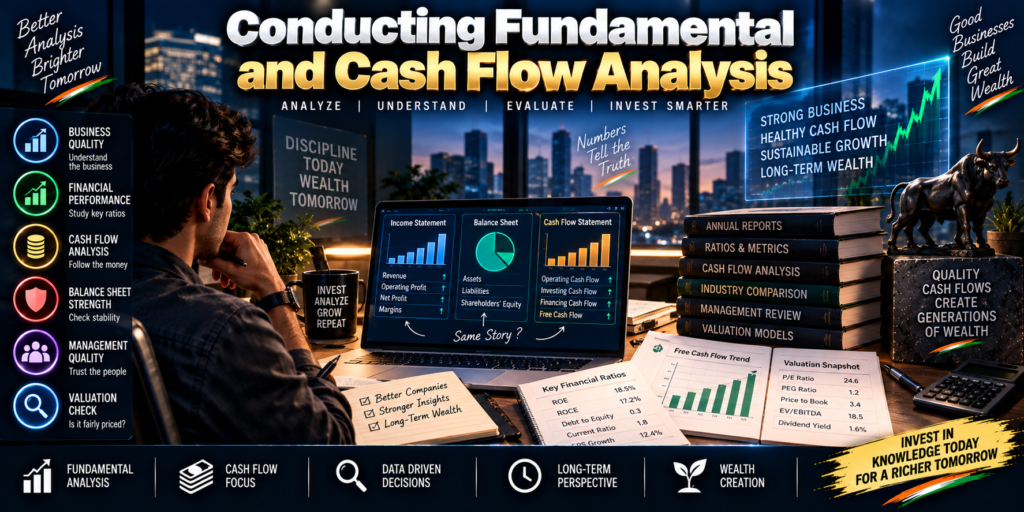
Once you narrow down your list to a handful of qualifying stocks, you must conduct a deep fundamental analysis covering the P&L statement, balance sheet, and cash flow statement. The cash flow statement is the most critical tool for dividend investors.
Specifically, verify that the operational cash flow is healthy and positive. If a company reports a negative operational cash flow, it means they are burning cash and may eventually need to borrow money or raise costly financing just to sustain their dividend payouts. Additionally, check for a positive free cash flow, which indicates the company carries significantly lower financial risk.
Crucial Thumb Rules for Investors
When executing a dividend investment strategy, adhere to these core rules:
- Avoid the Dividend Announcement Trap. Do not blindly purchase a stock simply because management declared an upcoming dividend payout with the intention of selling immediately afterward. Once the ex-dividend and record dates pass, the market automatically adjusts the stock price downward by an amount roughly equivalent to the dividend payout. Short-term trading around dividend dates rarely yields a profit.
- Commit to a Long-Term Horizon. Building a meaningful, compounding passive income stream requires a dedicated long-term commitment. Patiently holding a stock gives the company time to grow its annual payouts, maximizing your yield on cost.
- Optimize Your Tax Efficiency. Because dividends are fully taxable based on your personal income tax slab, look for legal methods to optimize your returns. For instance, some investors manage investments under the names of their parents or senior citizen family members if those individuals fall into a lower or zero-percent tax bracket.
Hidden Risks of Dividend Stocks
Dividend investing is not entirely risk-free, and you should watch out for two main dangers:
- No Payout Guarantees: A strong historical track record does not legally bind a corporation to pay future dividends. To gauge the stability of future payouts, carefully read the company’s official Dividend Distribution Policy. Some companies feature transparent, quantified intents—such as committing to distribute a minimum percentage of their Profit After Tax (PAT). Others feature ambiguous policies tied strictly to floating variables like internal capital expenditures or profit growth milestones, which lowers your predictability.
- Capital Loss Risk: The underlying stock price remains vulnerable to market dynamics. You might purchase a stock boasting a seemingly attractive dividend yield, only to watch the share price plummet over time due to deteriorating business fundamentals. A severe drop in stock price can easily wipe out all the passive income earnings you accumulated through dividend distributions.
Dividend Taxation and TDS Regulations
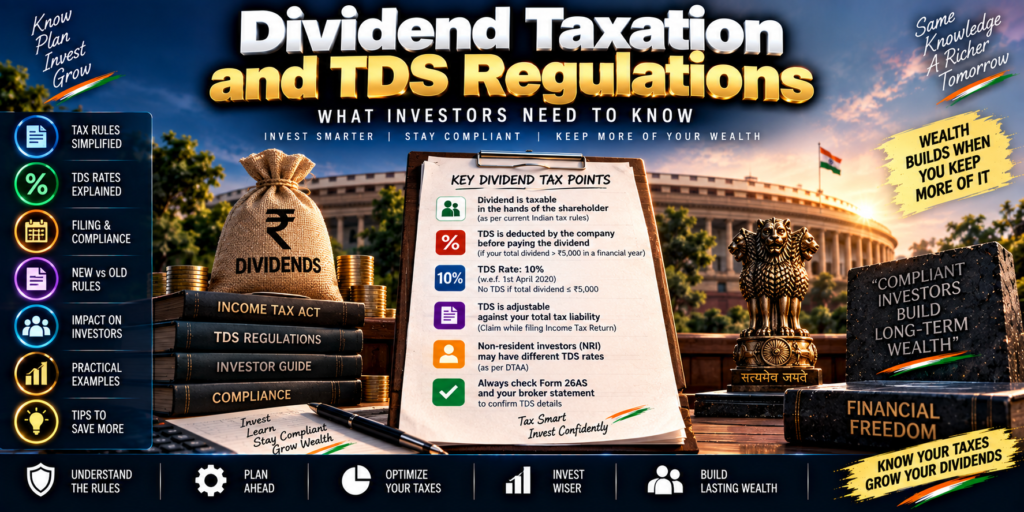
Under current regulations, dividend distributions are added directly to your personal annual revenue and taxed according to your applicable income tax slab. Furthermore, Tax Deducted at Source (TDS) mandates apply to these transactions. If a single corporation distributes a total dividend amount exceeding the government’s threshold to you within a financial year, they will automatically deduct a baseline TDS, provided you have updated your valid PAN card documentation with your brokerage account. Failure to link a valid PAN card can result in significantly higher punitive withholding tax rates.