Introduction and Valuation Erosion
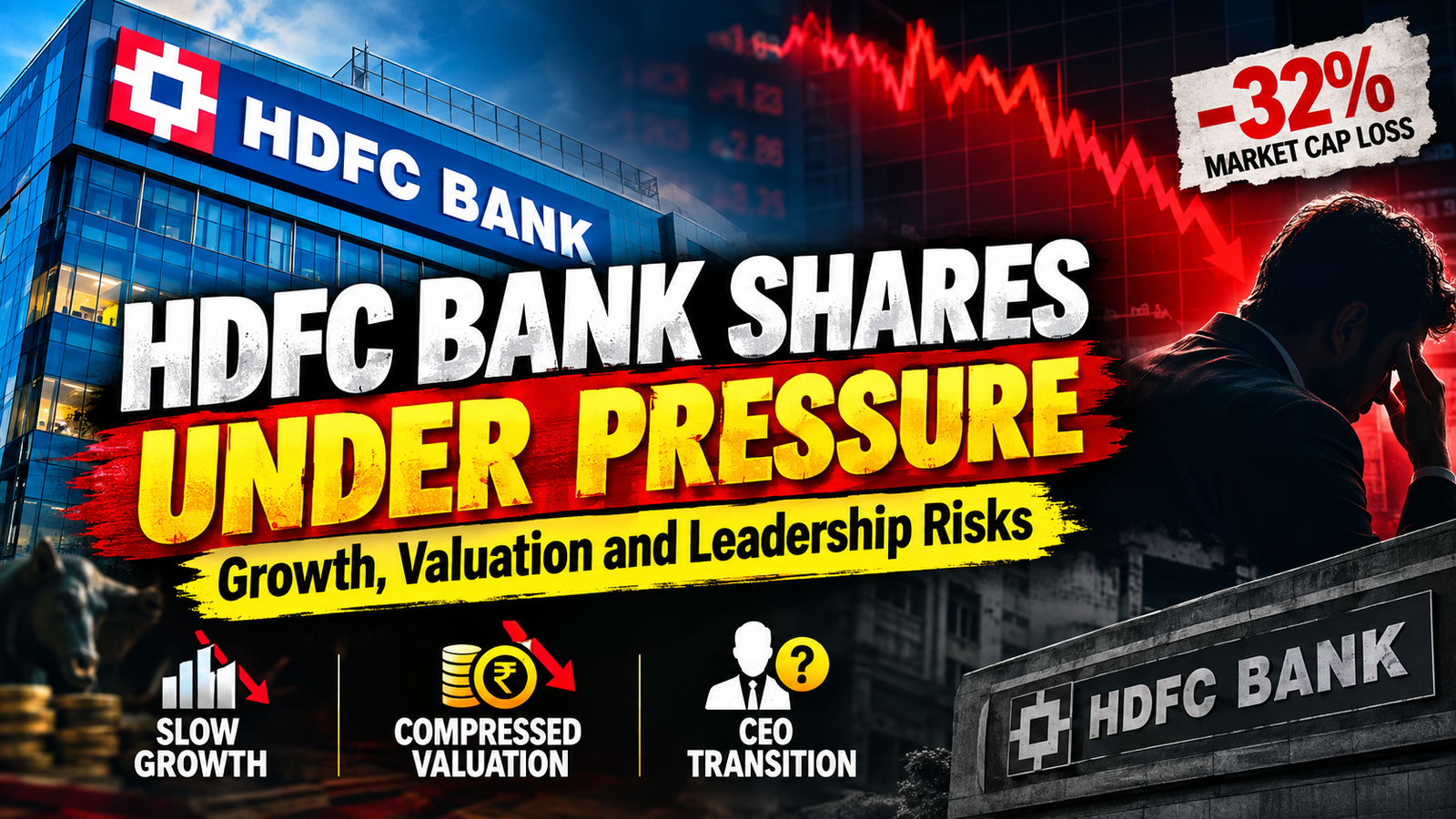
What should we say about this particular stock? If you look at the peak market capitalization of HDFC Bank, it used to stand at around 15.72 lakh crores. From that peak valuation, it has come down drastically to almost 10.59 lakh crores. This represents a massive loss of 5.13 lakh crores in market valuation, which is roughly a 32% erosion in value.
HDFC Bank is not the only company suffering within the group. At the group level, sister companies like HDFC Life, HDFC AMC, and HDB Financial Services have all lost money for investors. The group’s overall peak valuation used to be around 19 lakh crores, but it has now plummeted to nearly 13.6 lakh crores. If you are an existing investor in HDFC Bank, you might be crying, and I genuinely feel your pain. If you are a new investor looking to enter, you likely have a lot of questions. The primary questions on everyone’s mind are: Why is there so much pain in this stock when it hasn’t done anything for the last five years? How are the fundamentals looking post-merger? What is happening with the valuations? Finally, what lies ahead for HDFC Bank with the upcoming leadership transitions? We will unpack all of these critical insights. Please do not buy or sell a company based strictly on its price movement; you must understand the holistic picture to make informed decisions.

The Core Reason for the Pain: Loss of Trust
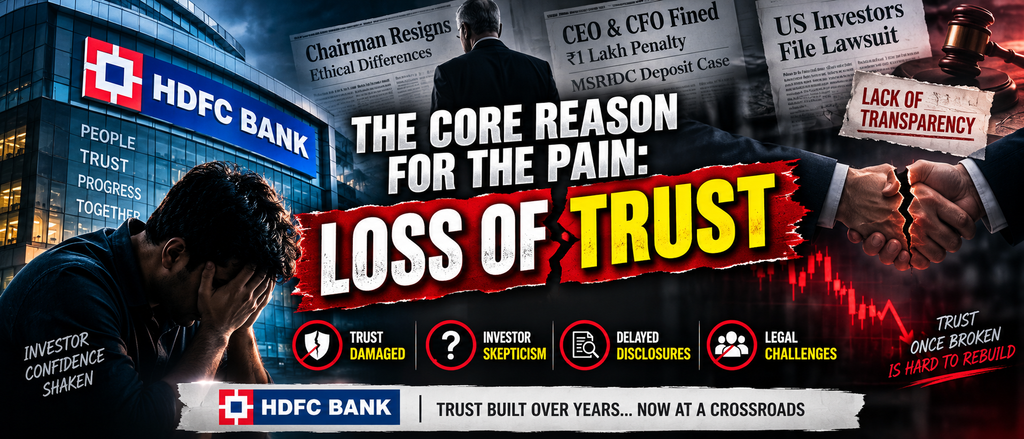
The key reason behind the extreme pain in HDFC Bank is a fundamental loss of trust among investors. To understand why this happened, we have to look back to when the chairman, Atanu Chakravarti, abruptly resigned due to ethical differences regarding the bank’s operations. In response, the bank set up a three-month internal legal review. Unsurprisingly, this legal review cleared the bank of any wrongdoing. It is akin to setting your own exam paper and clearing it with a perfect score. However, investor skepticism intensified when, just a month later, HDFC Bank itself fined its existing CEO, Sashidar Jagdishan, and the CFO a penalty of 1 lakh rupees over the MSRDC deposit case. The bank attempted to cover things up and failed to disclose the right information at the right time. This lack of timely transparency triggered a lawsuit against them by US investors. Consequently, investor confidence has been completely shaken, causing the stock to get heavily hammered. No matter how fundamentally strong you are as a financial institution, if you lose the trust of your investors, your stock will be beaten down.

There was a minor relief recently regarding the AT1 bonds issue controversy. Bahrain courts gave a clean chit to HDFC Bank, allowing them to win all seven ongoing cases. While this is a highly positive recovery, the stock price failed to react to the news because the foundational trust was already lost during the MSRDC deposit case. Once trust is broken, it is incredibly hard to win back.
CEO Transition: An Opportunity in Disguise

Adding to the uncertainty, CEO Sashidar Jagdishan announced that he will not extend his tenure beyond October. Rating agencies like Moody’s flagged this as a leadership risk since a new CEO will have to step in. However, in my view, this transition is actually excellent news because it creates an ideal opportunity for an incoming leader to clean up the existing mess. When this announcement dropped, I posted a detailed note to my exclusive YouTube community stating that I am officially shifting my stance on the bank from bearish to neutral. With the current CEO leaving, a new leader can turn things around. There are strong replacement candidates available. For example, Mr. Bharucha, the Deputy Managing Director, has been with the bank for 26 years. The bank can choose to source a candidate internally or look outside. This transition serves as a golden opportunity to pivot away from the struggles of the last few years.
Disappointing Post-Merger Fundamentals
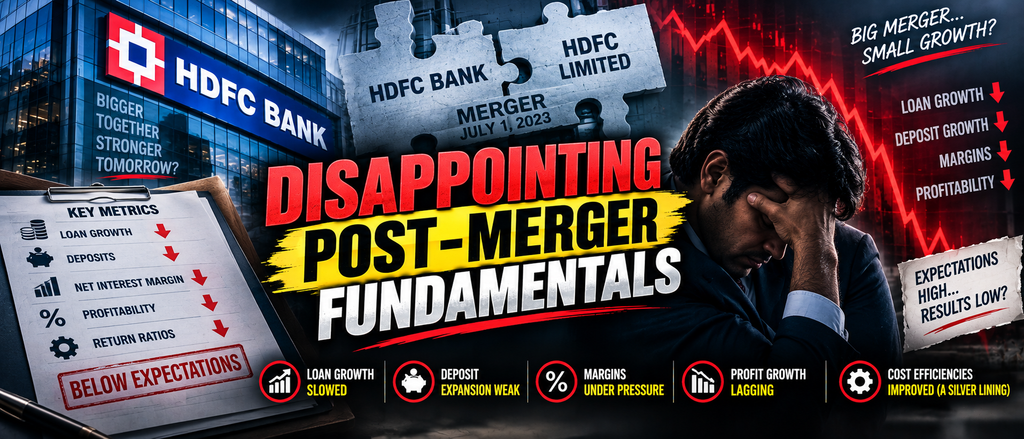
The historic merger became effective on July 1, 2023, meaning the financial metrics fully reflect the merged entity. When assessing post-merger parameters, certain numbers have performed well, while others have been highly disappointing. Let us look first at the loan book. Prior to the merger, HDFC Bank’s independent loan growth rate hovered robustly around 14% to 20%. Following the merger, the organic growth rate dropped drastically to figures like 5.4%, 4%, and 12.1%. Even though the two massive corporate entities merged—theoretically allowing them to cross-sell seamlessly to each other’s customer bases—that anticipated value has failed to unlock. The absolute loan book size artificially jumped 55% purely because the two balance sheets were combined, but subsequent organic growth has been completely stagnant.
A identical disappointing pattern is visible in deposits. While there was a combined peak right after the merger, subsequent deposit growth has languished around 14% to 14.4%. Prior to the merger, HDFC Bank alone was consistently expanding its deposit base at rates of 16.3%, 16.8%, and up to 20.8%. Given their expanded branch and structural reach post-merger, deposits should have surged, but we haven’t seen it happen. The lone silver lining on the fundamental side is the steady improvement in the Credit-to-Deposit (CD) ratio. The ratio originally crossed the 100% threshold, which raised immediate red flags among analysts because having higher outstanding credit than total deposits is structurally unsafe for a bank. Thankfully, that specific risk has been systematically minimized, bringing the CD ratio down to a safer 94.6%.
Downward Trends in Margins and Profitability
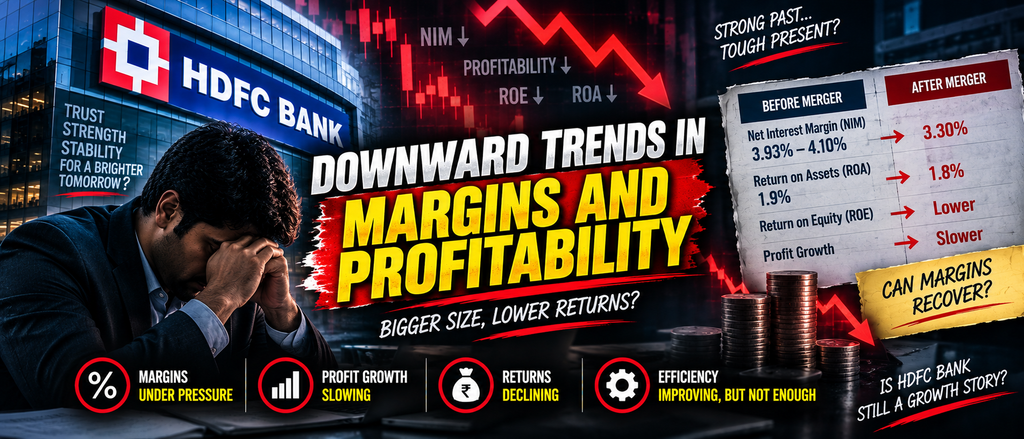
Another major negative is the Net Interest Margin (NIM) percentage. Before the merger, the bank boasted healthy NIMs of around 3.93% to 4.10%. Post-merger, it dropped heavily down to 3.30%. A margin compression was widely expected because HDFC Bank originally possessed an excellent CASA (Current Account Savings Account) ratio, which kept their overall cost of deposits incredibly low. Conversely, HDFC Limited did not have a CASA base; they relied entirely on higher-cost fixed deposits and raised institutional capital via high-interest bonds. This structurally dragged down the joint margins. Unlocking and recovering this NIM percentage hinges completely on rejuvenating underlying loan and deposit growth, but the current trend remains stubbornly downward.
On the bright side, looking at general operational ratios, the bank has captured some structural cost efficiencies. The cost-to-asset percentage has successfully dropped to 1.66%, and the cost-to-income ratio has improved to an excellent 38%, showing that mild operating leverage has finally kicked in. Asset quality also remains superb. Both Gross NPA and Net NPA show substantial and highly positive improvements, with Net NPAs resting at a fantastic 0.4%, proving that asset quality is not an issue. However, core financial profitability metrics like Return on Equity (ROE) and Return on Assets (ROA) have experienced a notable post-merger drop. ROA fell from 1.9% down to 1.8%, though it has remained stable since.
The primary overarching problem continues to be poor organic loan and deposit expansion, which directly chokes net profitability. For instance, HDFC Bank’s Net Interest Income (NII) is growing at a meager 4.9%. Their Profit After Tax (PAT) growth rate crawled between 10.7% and 10.9%. To put this into perspective, competing institutions like ICICI Bank have grown their annual PAT by a staggering 25% over the same timeline—outperforming HDFC Bank’s earnings growth by 2.5 times. Even if an investor intentionally ignores the structural issues with corporate trust, the financial fundamentals themselves fail to show anything impressive. The bank desperately requires a sweeping turnaround across both public trust and operational fundamentals, emphasizing why new leadership is paramount.
Valuations and Severe FII Outflows

When examining HDFC Bank’s valuation metrics, its Price-to-Book (PB) ratio has compressed down to roughly 1.79 times. This places its valuation incredibly close to Axis Bank, which trades at 1.75 times, while ICICI Bank commands a hefty premium at 2.61 times. To judge whether this compressed valuation is justified relative to its slowed growth, investors look closely at the Price/Earnings-to-Growth (PEG) ratio. As a general rule across the market, a PEG ratio below 1.0 indicates that a stock’s valuation has become highly attractive because the price has dropped much faster than the underlying growth deceleration. This exact PEG compression is why media channels and market commentators occasionally highlight HDFC Bank as a value buy. By comparison, Axis Bank’s PEG has dropped even lower to 0.41 without any of the corporate controversies plaguing HDFC. ICICI Bank has enjoyed stellar growth, but its premium has pushed its PEG up to 1.07, making it trade at an expensive premium. Looking long-term, HDFC Bank’s 10-year median PB ratio used to be 3.5, but sentimental damage and lack of growth have yanked it below 2.0.
Compounding this, Foreign Institutional Investors (FIIs) are heavily dumping Indian banking equities. Data shows massive systemic liquidations, including an astonishing 1,100 crores of financial sector selling in a single session. FIIs are retreating due to inflation fears stemming from the escalating US-Iran geopolitical conflict, which naturally forces a bearish drawdown across the Nifty Bank index. Furthermore, FIIs are aggressively reallocating capital away from traditional banking avenues into primary market IPO offerings and emerging AI growth stories. HDFC Bank is highly vulnerable to this macro drain because it lacks unique fundamental drivers to retain foreign capital. To illustrate this exodus, FII ownership in HDFC Bank plummeted from 52% down to 41.82% recently, reflecting a consistent stake reduction of roughly 3% quarter-on-quarter.
What Lies Ahead for HDFC Bank
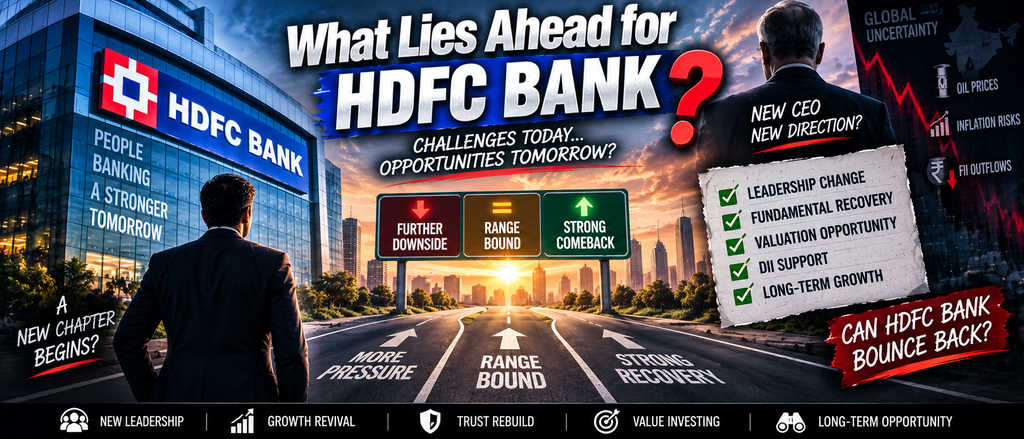
Looking forward, the highly anticipated announcement of the new CEO’s identity is expected within the next few weeks. The stock market will immediately bet heavily on the precise credibility, pedigree, and historical track record of the person named. Realistically, no executive can instantaneously fix the bank’s deep fundamental issues; a new CEO will require an absolute minimum of three to four quarters to properly audit the business operations and initiate core improvements. Consequently, organic data improvements will remain absent in the near term. However, stock prices move rapidly on the anticipation of fundamental shifts rather than the lagging data itself. If the incoming CEO carries immense public credibility and a proven history of executing complex turnarounds, the stock price could react powerfully the exact day the name is announced.
Concurrently, macro risks persist. The US-Iran situation is deteriorating, pushing global crude oil prices past $100 per barrel. This keeps inflation fears high and maintains continuous structural pressure on the banking sector, a headwind HDFC Bank cannot escape. On a positive note, because valuations have dropped significantly, we might observe Domestic Institutional Investors (DIIs) and mutual funds stepping in to buy. Buoyed by robust, continuous retail SIP inflows, mutual fund houses may view the sub-2.0 Price-to-Book valuation as an exceptional accumulation zone for a 10-year investment horizon.
Ultimately, my view is that the stock will remain heavily range-bound until the market receives absolute clarity on the incoming CEO. Predicting a definitive trajectory is difficult because there are zero concrete signs of operational reversal on the horizon. The bank isn’t going to land a magical 100-crore order tomorrow to fix its margins; everything hinges entirely on the new CEO’s background and execution capability.
What are your thoughts on this? Do you believe HDFC Bank will successfully rebound, remain entirely range-bound, or face further downward pressure in the coming days? Let me know your perspective in the comment section below