
Don’t skip this article read full article to understand properly. Very, very, very important article. Let’s assume that you have 50,000 rupees per month extra that is ready to be used and you have four options in front of you, Option number one is that you put this 50,000 rupees per month in stock market SIP.
Option number two is use this 50,000 rupees per month to buy gold every single month, Option number three is that you take a loan. With that loan you buy a land, and you put this 50,000 rupees per month for clearing out that loan in the next few years, Option number four is that you already have a home loan going on. You want to use this 50,000 rupees per month to pay off that home loan early.

Out of these four options, which option would you go for? I’m going to give you 3 seconds to make your decision: 3, 2, 1. If you have made your decision, let me know in the comments. It’s very, very important you write down your option in the comments. Generally, whatever decisions we make in first impression few seconds, they are biased by something called as primacy bias, and generally decisions made using primacy bias go horribly, horribly wrong.
In this video, I’m going to break down how to think about these four options because there are hundreds of variables here and this is a very, very tricky decision. It is not an easy decision to be made at all. my name is jaikrishna. Hit that With that, let’s get this video cracking. For me to be able to make this decision, there are two factors. Factor number one is how much wealth I am likely to make in each of these options—let’s say 20 years down the line. And number two is what will my next 20 years look like in terms of my experience, because in each of these options there will be problems coming my way. 20 years is such a long period of time. Keeping these two factors in mind, I’m going to make my decision. So let me run you through each of these options in detail
Option 1: Stock Market


Option 1: Stock Market SIP Option number one is putting this extra 50,000 rupees per month in the stock market SIP. Now, stock market is a very vast area. You could do SIPs in stocks, active mutual funds, index mutual funds, ETFs, the Indian stock market, or global stock markets. There are a hell of a lot of options. I’m going to simplify this and take four to five simple examples using the last 20 years of historical return data, because I don’t know what the future will look like. I’m going to forecast my returns or my wealth based on the last 20 years for a like-for-like comparison, because nobody knows what will happen in the next 20 years.
Nifty 100 (Large Cap):

If you look at the last 20 years of SIP performance of Nifty 100, the returns we have got is around 13.16% CAGR basis annual returns. You would have invested 1 crore 20 lakhs in principal over the next 20 years, and that 1 crore 20 lakhs would become around 5 crores 30 lakhs.
Midcap 150:
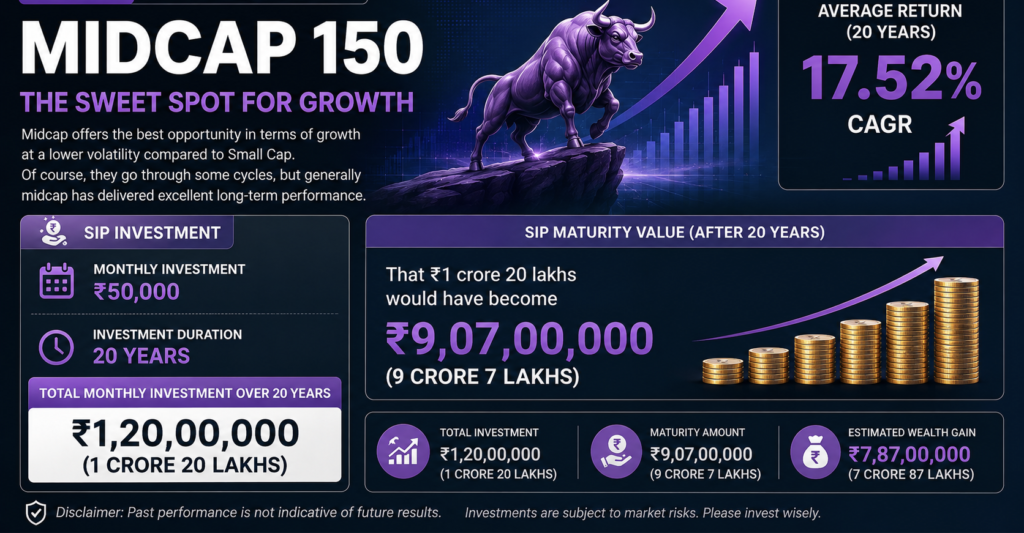
If you follow me, you would know that I’ve been saying for a number of years that midcap offers the best opportunity in terms of growth at a lower volatility compared to small cap. Of course, they go through some cycles, but generally if you look at midcap performance in the same period last 20 years, the SIP performance of the midcap 150 index has been around 17.52% CAGR basis. The same 1 crore 20 lakhs would have become 9 crores 7 lakhs.
Small Cap 250:

Here, the CAGR return has been around 14.9%. Your 1 crore 20 lakhs would grow to around 6 crores 56 lakh rupees.
Nifty 500:
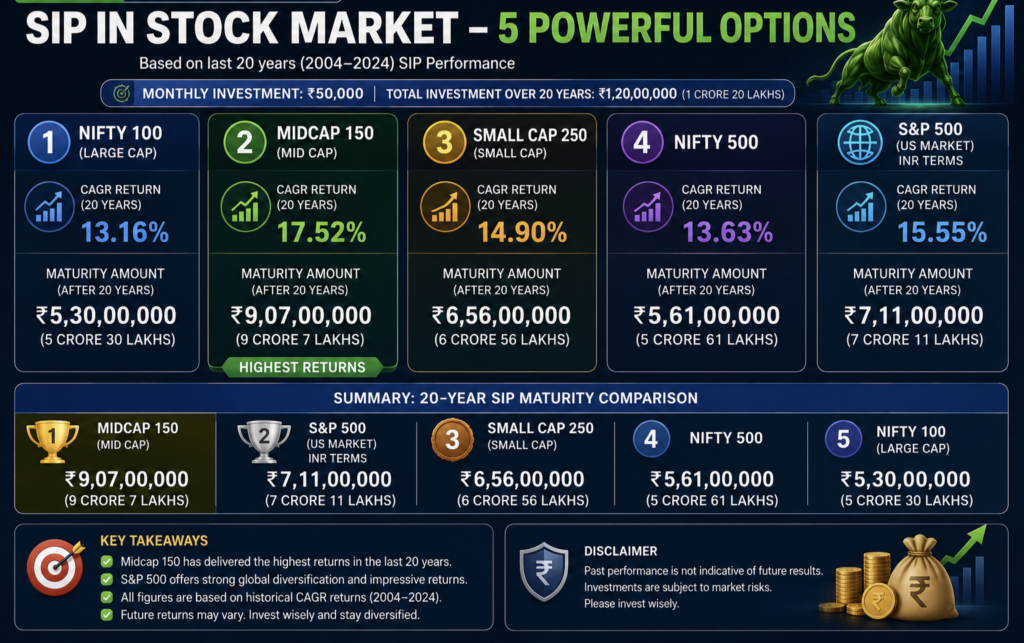
If you are going to put your money on Nifty 500, assuming the 13.63% CAGR returns it delivered in the last 20 years, this 1 crore 20 lakhs could become 5 crores 61 lakhs.
S&P 500 (US Market): Let’s put that in the mix as well. S&P 500 in INR terms—very important, meaning that we have taken care of the currency depreciation as well here. It comes out to be around 15.55% of CAGR returns. 1 crore 20 lakhs could have become 7 crores 11 lakh rupees. To summarize the five stock options: Midcap 150 delivered the best returns at 9 crores 7 lakhs, S&P 500 is number two at 7 crores 11 lakhs, Small Cap 250 is third at 6 crores 56 lakhs, Nifty 500 at 5 crores 61 lakhs, and Large Cap 100 at 5 crores 30 lakhs.
Pros & Cons of Equity
Let’s qualify these hard numbers from an experience perspective.
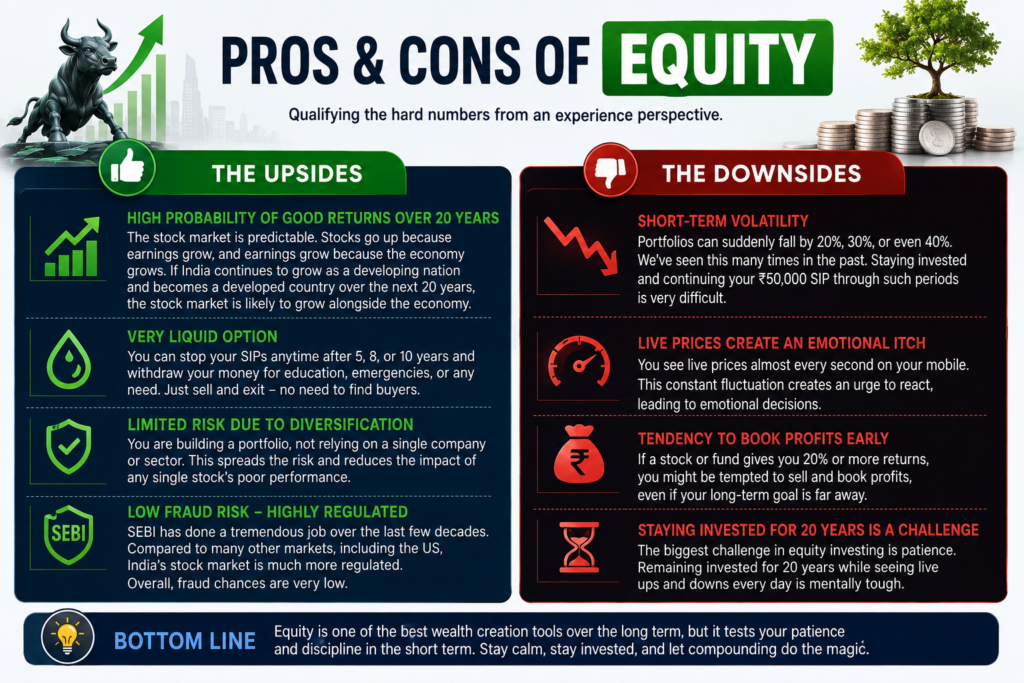
The Upsides: Your probability of making returns from the stock market over 20 years is high because the stock market is predictable. Stocks go up because their earning pressure goes up, and earning pressure goes up because the economy grows. If we think the Indian economy is likely to grow because we are still a developing country and could become a developed country 20 years down the line, there is a strong chance that the stock market will grow alongside the economy. In the short term, it can correct 20%, 30%, 40%, but over 20 years, predictability is very high.
It is a very liquid option. If you want to stop your SIPs after 5, 8, or 10 years and take all your money out for a daughter or son’s education, or an emergency, it’s a very liquid option. Sell it off, come out. You don’t need to find buyers; you can just sell off and dump your stuff. You are not taking a lot of risk here because you’re making a portfolio. You’re not relying on one company or one particular thing. Therefore, the risk is very limited. The chances of fraud are very limited because it’s highly regulated. SEBI has done a tremendous job in the last few decades. Even if you compare it with the US stock market, I would say the Indian stock market is much more regulated. Overall, fraud chances are less here.
The Downsides: Short-term volatility. All of a sudden, portfolios come down by 30% or 40%. We have seen that in the last few years. To remain invested and continue to do a 50,000 rupees per month SIP through that is practically very hard.
You see It is a very liquid option. If you want to stop your SIPs after 5, 8, or 10 years and take all your money out for a daughter or son’s education, or an emergency, it’s a very liquid option. Sell it off, come out. You don’t need to find buyers; you can just sell off and dump your stuff. You are not taking a lot of risk here because you’re making a portfolio. You’re not relying on one company or one particular thing. Therefore, the risk is very limited. The chances of fraud are very limited because it’s highly regulated. SEBI has done a tremendous job in the last few decades. Even if you compare it with the US stock market, I would say the Indian stock market is much more regulated. Overall, fraud chances are less here. prices almost on a daily basis—forget daily, on a second-by-second basis. When that happens, you have an itch to sell. If all of a sudden a stock, index fund, or mutual fund has given you a 20% upside, you might just sell off because you made good money. Remaining invested for 20 years is a problem in the stock market because you see the live prices on your mobile almost on a daily basis.
Option 2: Gold Investment

Option number two is buying gold every single month using 50,000 rupees. Physical gold, ETFs, or mutual funds—that is your choice, it doesn’t really matter much. Looking at past data for the exact same 20-year time period using domestic prices of gold in India (removing duties, etc.), the CAGR returns come out to be around 15.11%. To my surprise, actually, gold has done pretty well, mainly because in the last one year or so it has almost doubled. The entire rally has come in just one year. Because of those 15.11% CAGR returns in the last 20 years, 1 crore 20 lakhs could have become 6 crores 73 lakhs. Not bad at all.
Pros & Cons of Gold
The Upsides:
The probability of making returns in gold is also high because gold is recognized globally as a store of value. Given what is happening right now geopolitically, where there is a lack of trust in countries, gold becomes more and more valuable for the future.
Much like SIPs, gold is a very liquid option. You can sell it anytime and come out. There are enough buyers whether it is ETFs or physical gold. You can go to any store and sell it anytime. In fact, you can carry it with you globally; it is a global currency.
The chances of fraud are very small. If you’re using gold ETFs or gold mutual funds, they are highly regulated. Even if you’re buying physical gold, nowadays the government has made sure there are hallmarks, and if you go to a reputed jeweler, you’re not going to get scammed. Potentially, once you buy gold, you’re not checking the prices daily like you do with stocks or mutual funds. Generally, Indians do not offload their gold easily; they keep it for generations, for daughters and grandchildren. That makes it easier to remain invested.The Downsides:
Gold is also very volatile. Much like SIPs in the stock market, you will see gold correcting by 15% or 20%.
There can be long periods of stagnant returns. It can happen that for a 10-year or 12-year period, gold may not even beat FD returns. Then all of a sudden, in a 1, 2, or 3-year period, a rally will break out. The nature of gold is that you really have to be very calm about it, otherwise, during those slow years, you might think, “Yeah, what have I done here?”
Option 3: Buying Land with a Loan

Coming to option number three: taking a loan and with that loan amount buying a plot or a piece of land, and then paying EMIs of 50,000 rupees per month. In order to do this, let’s say I’m going to take a loan of around 60 lakh rupees. If I take a loan of 60 lakh rupees at an 8% interest rate for the next 20 years, my EMI comes out to be around 50,000 rupees per month. I’ve not included other costs like registration or stamp duty because I want to focus on the basic concepts here. You might ask me what you can get for 60 lakhs; it is entirely possible in smaller towns or on the outskirts of big cities. I recently bought a piece of land for around 43 lakhs, so it is possible.
The trickiest question here is: how much can the plot appreciate in the next 20 years? I spent two days looking on the internet for credible data and couldn’t conclude a single number because it depends on thousands of variables and localities.
One 30-year study concluded that house prices in India have gone up by around 9.3% CAGR basis over a 30-year period.
Looking at Delhi circle rates from 2011 onwards, they have gone up by almost four times from 2 lakh 15,000 to almost 7 lakh 75,000, though there were long periods of no revision followed by steep spikes.
In Kolkata, it’s a vague figure of 2% to 10% CAGR depending on the locality.
In Chennai and Tamil Nadu, it’s around 5.6% to 6% CAGR.
In Mumbai, it’s around 5% to 8% CAGR.
Then there are anecdotal situations. I found a guy saying he bought land for 60 lakh rupees an acre and in 10 years it went 10x because some heavy development or an airport came nearby. To look at potential returns, I have considered four base scenarios for how much your 60 lakh property could be worth after 20 years:
4% CAGR: A very low, abysmal return where property prices double every 18 years. Your plot is worth around 1 crore 31 lakhs.
8% CAGR: Property prices double almost every 9 years. It comes out to be around 2 crores 79 lakh rupees.
12% CAGR: Land prices double almost every 6 years. The plot would be worth 5 crores 78 lakhs.
18% CAGR: Plot prices double every four years, taking the value up to 16 crores 43 lakhs. It could be anything; that is my point.
Pros & Cons of Land
The Upsides:
Land supply is limited. God has stopped making more land. You will have more companies getting listed on the stock market and more gold being mined, but you can’t make more land. It is absolutely limited in supply. Therefore, it is a store of value not just for 20 years, but potentially for 200 or 2,000 years. Your grandchildren’s grandchildren could use that piece of land. That is the beauty of buying land.
You do not see the prices of land going up or down on a daily basis. That is the best thing about land, and that is why maximum people can remain invested in property for 20 years without blinking an eye. Because they are not seeing the price, they are not getting affected. You will often hear stories like, “I got a land 20 years back and it is still there,” but very few people will tell you, “I bought a Reliance stock 20 years back and I still hold it.”
The Downsides:
Price appreciation is completely unpredictable. There is no EPS growth rate like stocks, and no globalization factors like gold.
For long periods of time, the price of the land may not appreciate at all, until suddenly something develops nearby and the price jumps 5x or 10x.
The chances of fraud in land are extremely high in India. In every single city across India, there are instances of someone trying to do an illegal “kabza” (encroachment) on your plot.
It is highly illiquid. If you want to sell it off, you have to find a buyer and make sure you get a fair price. It’s not like SIPs or gold where you can sell anytime and instantly come out.
Option 4: Home Loan Prepayment

Option number four applies if you already have a home loan going on, and you use this 50,000 rupees per month to pay off that loan early for mental peace. Let’s do some calculations. Assume you already have a home loan of 1 crore taken for 20 years at an 8% interest rate. You are already paying around 66,000 in EMI, and the loan is scheduled to finish in 2046. If you start making a 50,000 rupees prepayment every month after year 2 or 3, your loan duration will come down from 20 years to potentially 10 years. You will clear your loan by 2035. Meaning that after 2035, for the remaining 10 years, the entire amount you were shelling out—your original 66,000 EMI plus the extra 50,000 prepayment (totaling 1,21,000 rupees per month)—is now unlocked. You can now invest that 1,21,000 rupees into either gold or the stock market for the remaining 10 years.Assuming you get the same returns over those remaining 10 years as the historical 20-year averages, here is the wealth you could generate:
Midcap 150 (17.52% CAGR): 3 crores 64 lakhs
S&P 500 (15.55% CAGR): 3 crores 27 lakhs
Gold (15.11% CAGR): 3 crores 20 lakhs
Small Cap 250 (14.9% CAGR): 3 crores 16 lakhs
Nifty 500 (13.63% CAGR): 2 crores 95 lakhs
Large Cap 100 (13.6% CAGR): 2 crores 88 lakhs
Depending on your situation, whether your loan is 70 lakhs or 80 lakhs, the exact numbers will vary. But broadly speaking, paying off your loan early unlocks a large amount of monthly surplus that can still generate decent wealth (2 to 3 crores) in the remaining years.
Pros & Cons of Prepayment
The Upsides: Mental peace. You don’t know what’s going to happen in the world in the next 10 years. AI is coming, and jobs might be lost. It’s better to pay off your loan if you have the money so you can sleep very tightly and soundly at night.You still make decent money because you can aggressively invest the unlocked 1,21,000 surplus for the remaining 10 years.The Downsides: An 8% home loan is not actually very costly. You could have made 12% or 15% by investing that extra money instead. You are losing the opportunity to compound wealth over a much longer 20-year period. Nowadays, investing in the stock market has become very easy because you have all the technology and information—you can even use Claude or ChatGPT to analyze a stock. By prioritizing an 7-8% loan payoff, you might miss a massive wealth creation opportunity.
You might not leave a lot of initial wealth for your children or grandchildren because a huge portion of your life’s surplus went entirely into clearing debt first. An 8% home loan is not actually very costly. You could have made 12% or 15% by investing that extra money instead. You are losing the opportunity to compound wealth over a much longer 20-year period. Nowadays, investing in the stock market has become very easy because you have all the technology and information—you can even use Claude or ChatGPT to analyze a stock. By prioritizing an 7-8% loan payoff, you might miss a massive wealth creation opportunity.
Final Verdict & Ranking

It is absolutely difficult to make this decision because it depends entirely on your personal circumstances and what you are naturally good at. However, if I were to make this decision for myself, this is how I would rank these four options:
Rank 1: Equity (Option 1). I would any day go for equity because it is the most predictable over the long term, and it’s a massive ocean of huge opportunities if you know how to invest. Personally, I feel I am very good at equity investing versus any other option, and I cannot argue or fight with people, so this suits me best. If you understand the stock market, go with Option 1.
Rank 2: Real Estate / Land (Option 2). Go with this only if you are genuinely good at real estate, can find great locations, and have a thick skin. You need to be okay dealing with a bit of corruption, arguing with contractors or police, and potentially going to courts to protect your plot. If you’re a fearless person who can handle that, real estate can be an incredible wealth creator. Most 9-to-5 workers aren’t good at this and end up creating a headache for themselves.
Rank 3: Gold (Option 3). If you don’t understand equity and don’t understand real estate, and you can’t take those specific risks, gold is a complete no-brainer. Our grandparents taught us this; you don’t need to go to school for it. You cannot time gold prices, but the long-term trend is a reliable store of value. Continuously putting money here for 20 years is a solid, safe path.
Rank 4: Home Loan Prepayment (Option 4). If you are someone who truly values debt-free living and needs absolute mental peace, choose this. If you feel your job is on the edge, you are the sole breadwinner, or your family circumstances require zero risk, sleeping soundly at night without debt is a beautiful thing. Please remember, you can also make a balanced, diversified allocation. You can put 25,000 in gold and 25,000 in equity, or mix gold and real estate.
The intent of this video is to give you the underlying nature of these assets. Hard historical numbers cannot guarantee future forecasts, but understanding the asset’s nature allows you to complement it with your own knowledge, skills, risk tolerance, and behavioral psychology. Your own emotions and behavior should decide your investing decision—not what I or anyone else tells you. If you would like to map out a specific investment strategy based on these paths, let me know your current investment timeline or your risk comfort level, and we can explore options tailored to your goals.