
Hi friends, if you want to build wealth always remember these two rules: rule number one is protect your capital, do not take unnecessary risk. Number two is let the data make investing decisions for you; don’t allow emotions to make your decisions. In this video, I’m going to run you through five investing strategies that are built around these two rules. I’ve been personally using these investing strategies. You’re going to learn a lot in this article and are going to not make those mistakes that you’ve been making for a number of years.

📈 Strategy 1: The Laddering Strategy (Lumpsum Investments)

This strategy applies to lumpsum investments. Whenever you want to invest any lumpsum amount—be it 5 lakh rupees, 50,000 rupees, or 5 crore rupees—you need to use this laddering strategy. Let’s take an example of gold. Right now, gold is down by almost 24%. Of course, it’s not a recommendation, but let’s assume hypothetically you want to put 10 lakh rupees in gold. Should you go and put that entire 10 lakh in one go, or should you stagger it out? In my view, you should stagger it out in multiple batches because you don’t know whether gold prices will come further down or whether they will go up. Nobody can really predict where the market or prices will go.

By staggering it out, you are averaging your cost and you’re not going to panic. Just imagine putting 10 lakh rupees at this price right now; if gold goes down by 5% in the next few days, you will panic and immediately try to sell it off. That volatility is what you need to avoid so that you can remain invested. A lot of people see their P&L in red, panic, sell off, and book losses. We don’t want to do that, assuming you are investing for the long term—maybe 5, 7, or 10 years.
Now, how many multiple batches should you use to invest your lumpsum amount? There is no thumb rule here, but let me show you some data about the Nifty 50. This is Nifty 50’s last 25 years of data. Whenever you’re investing a lumpsum in Nifty 50, a minimum 7 years is considered a very good time period so that your returns expectations are better. Past data track record shows it is likely to give you more than 10%. I’ve taken two scenarios. Scenario one is putting all your lumpsum money in one go. Scenario two is staggering your money around 6 months across six multiple batches. Overall, if you hold this money for 7 years, there is not a much difference in the returns because spreading it out over 6 months averages out over a 7-year period.
But the real difference is in year one. Look at when the market was down by around 50%. Someone who put a lumpsum in one go would see their portfolio drop by 50%, while in the staggered scenario, it only dropped 41%. There is less volatility. Conversely, during a bull run, the market went up by almost 79% in one go, but with 6 months of staggering, you got 93%. In both bull and bear markets, 70% to 80% of the time your volatility will be lower. Over the long term it may not matter, but you need to be in the game to remain invested. When year one shows huge volatility, we panic, sell off, book losses, and never return to that asset class because we burnt our fingers. Just make sure you put your money under three, four, or six batches depending on your risk appetite.
If you want to automate this in mutual funds, you can use an STP—Systematic Transfer Plan. If you want to put 12 lakh rupees, you first put it into a liquid mutual fund, and then set up an automated STP to transfer 2 lakh rupees monthly into your chosen target mutual funds. This automatically shifts the money on your selected date. This facility is available in mutual funds and some stock brokers, but if you’re buying physical gold, you will have to do it manually. Spreading out your risk helps you stick with your investment.
💰 Strategy 2: The Gunpowder Strategy (Keeping Cash Ready)

This sounds fancy, but let me simplify it. Nifty 50’s intra-year decline shows a temporary drop of 10% to 20% almost every single year. We need to have money in cash ready so that whenever this happens, we can deploy that cash. History shows that every 7 to 10 years, deeper market corrections occur where the Nifty declines between 30% to 60%. During the COVID crash, the Sensex fell from around 42,000 to almost 25,000—nearly a 50% drop. Imagine putting money at that time; within 5 or 6 years, the Sensex went up three and a half times to near 80,000.
Midcaps and small caps are even more volatile. Within a year, Nifty midcaps are below 10% on 47% of the days, and small caps are down by 10% on almost 64% of the days. These are great opportunities because valuations are down. Even gold goes down temporarily by 10% to 15% every single year. Looking at equity segments, sectors also show underperformance; for instance, the real estate sector hit an all-time high but subsequently went down by 17%. You need to keep gunpowder or cash ready to deploy when fear kicks in.
I keep a watchlist of individual stocks and will only buy them if the price drops to a certain level. For example, when US-Iran war tensions kicked in, midcap 150 subsequently rallied 22%, small caps rallied 28%, and micro caps rallied around 35% within a 3 to 4 month period because people deployed cash. You can keep this cash in debt mutual funds or fixed deposits. If you don’t want the complexity of debt funds, FDs are the simplest option. You can use platforms like Stable Money, which has over 60 lakh users. All bank FDs are insured by the RBI subsidiary DICGC up to 5 lakh rupees per bank per PAN card to cover your risk.
⏳ Strategy 3: The 7-Year Rule for SIPs
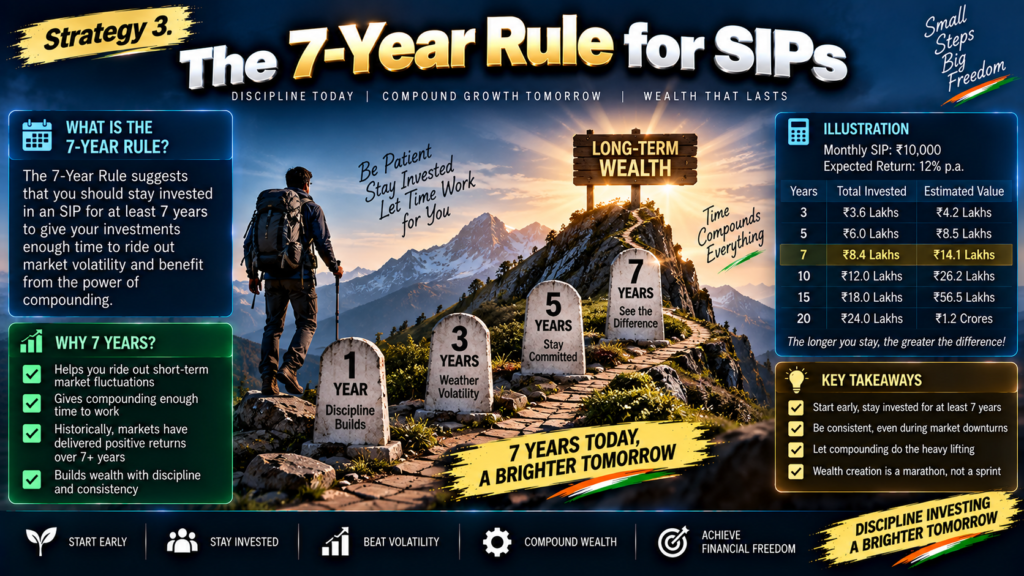
Whenever you start an SIP in any asset class, the minimum time period you must commit to is 7 years. Historically, if you do SIPs for 7 years in Nifty 50, past data tracks show an 80% probability that your returns will be more than 10% CAGR. A lot of people who start an SIP for just 1, 2, or 3 years panically say SIPs are bad because the Indian stock market didn’t give much returns over a short two-year stretch. SIPs aren’t bad; you just have to remember the 7-year rule.
We see a very similar pattern in the US stock market with the NASDAQ 100. Doing a minimum 7-year SIP highly elevates your chances of generating over 10% compared to doing it for a short time. My analysis with gold shows a similar 70% possibility of generating more than 10% CAGR over a 7-year minimum gold SIP. While we cannot forecast the future, the past data signals a strategy we should embed into our investing style: do not start an SIP if you do not have a minimum 7-year time horizon, and once you start, do not stop it.
📋 Strategy 4: The 5-Year Holding Strategy for Direct Stocks

A common question is how long we should hold direct stocks. It depends on the stock, but I did a study on the top 500 stocks. Out of those, only 400 stocks have been listed for 5 years or more. Looking at their last 5 years cumulative annual CAGR returns, 341 stocks generated positive returns while 59 generated negative returns. This means 85% of stocks gave positive returns if held for more than 5 years, and only 15% generated negative returns.
Breaking down the positive side, one stock generated a massive 356% CAGR, two stocks generated over 100% CAGR, about 35 stocks generated over 50% CAGR, and 124 stocks generated over 25% returns. Meanwhile, 292 stocks generated more than 7% CAGR, beating typical FD returns. Looking at the 59 stocks that made losses, the maximum loss was around 18% CAGR, seven stocks lost 10% or more, and the remaining lost lower than 10%. Your holding period determines whether you make or lose money, and 5 years dramatically reduces the probability of a loss.
🎯 Strategy 5: The Limit Order Strategy
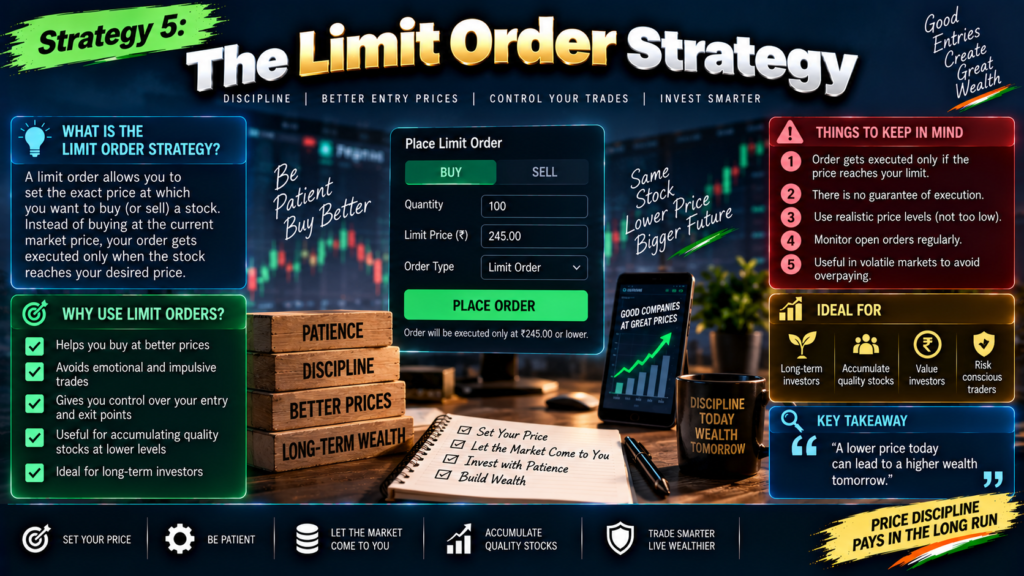
Whenever I buy stocks, I do not place a market order; I always put a limit order. In fact, I put three limit orders to average out my buying price. In your demat account, you can create a basket and add the same stock three times. For instance, if you add Reliance, you can set the first limit order at 1275, the next at 1270, and the third at 1268. If the price drops during the day, you catch it at three distinct, lower points instead of deploying all your money in one go.
This is crucial for investors deploying lakhs of money where order sizes are huge. Stock prices move a lot during the day, so placing three limit orders ensures you aren’t just buying blindly at market price. If the orders execute, great; if not, you can wait because the market fluctuates. These five strategies are built around protecting your capital and letting data dictate your choices over emotion.