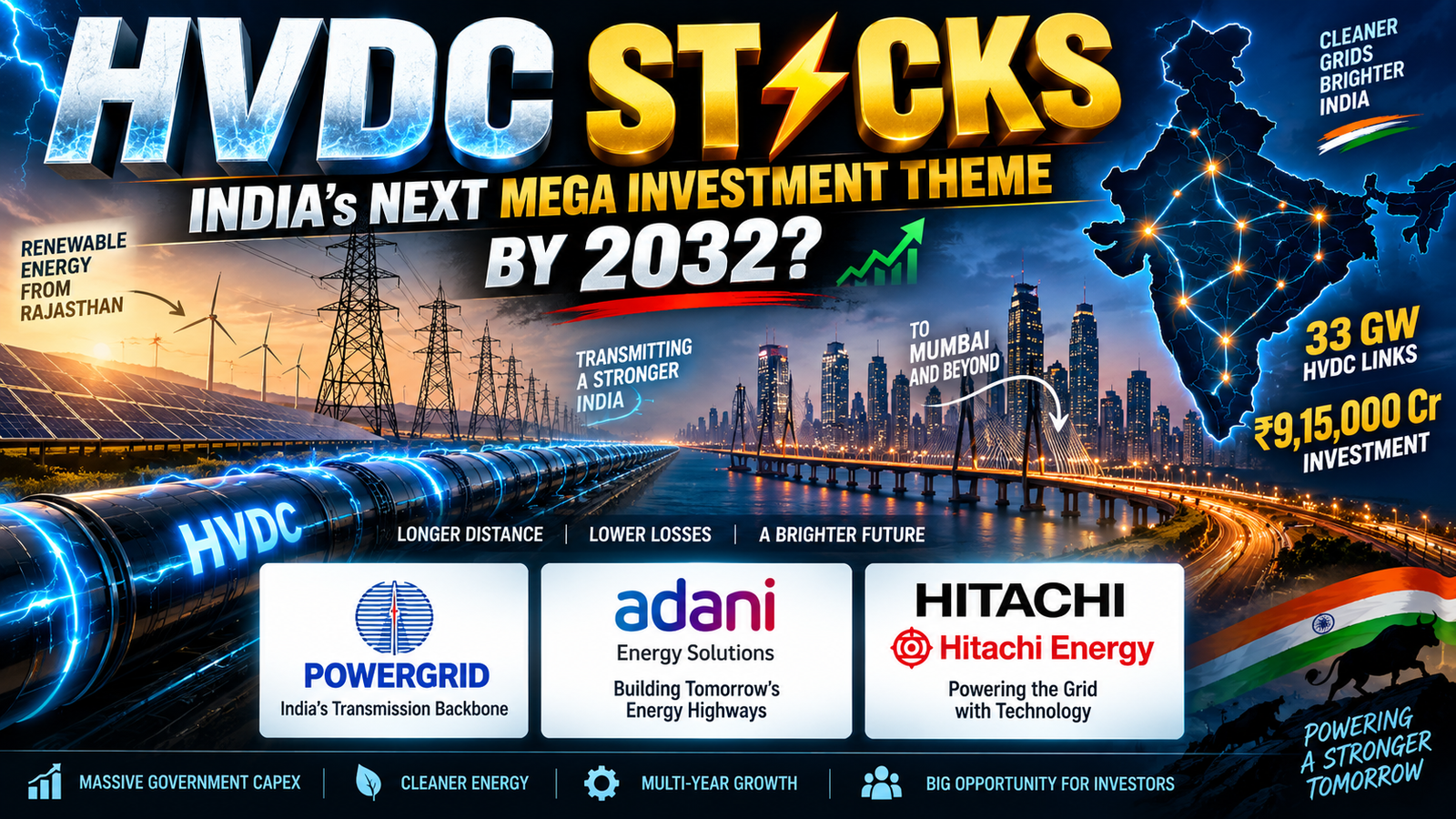
Hi friends, my name is srikrishna, Hitachi and Adani Energy made an announcement regarding the HVDC city center project in Mumbai, which will power electricity for 20 million people. This is a massive step change in India’s energy sector that has driven huge momentum for a few stocks operating within the HVDC theme. Their prices have gone crazy. In this video, I will walk you through what HVDC is, the strong tailwinds behind it, and the top three companies in this segment. In my view, this is not a temporary trend; it is likely to last providing a massive multi-year tailwind. Everything I share will be backed by data. If you are new to the channel, please don’t subscribe just yet—watch for a few minutes, and if you find these insights valuable, you are welcome to become a lifelong member. Let’s dive straight into it.

The Problem and The National Electricity Plan
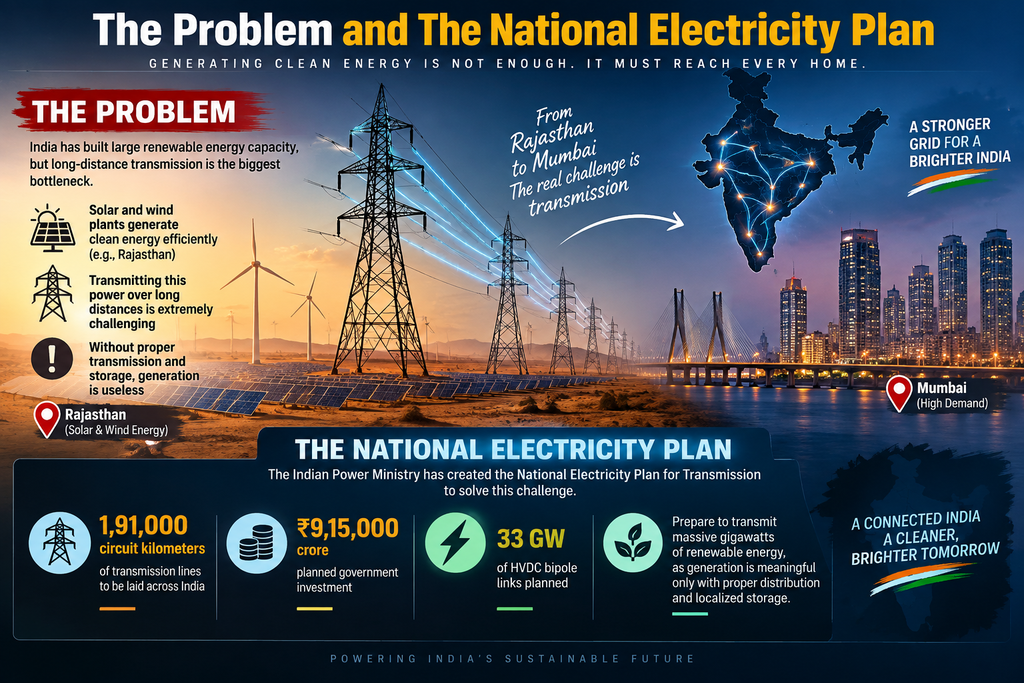
To understand HVDC, we must first look at the core transmission problem facing India. While the country has built exceptional renewable energy capacity, including solar and wind plants, long-distance transmission remains the bottleneck. For instance, if power is generated efficiently via solar plants in Rajasthan, transmitting that electricity all the way to a high-demand hub like Mumbai is extremely challenging. To solve this, the Indian Power Ministry created the National Electricity Plan for Transmission. The plan states that India must be prepared to transmit massive gigawatts of installed renewable energy, as generation is useless without proper distribution and localized storage infrastructure. Consequently, the Central Electricity Authority (CEA) intends to lay down roughly 1,91,000 circuit kilometers of transmission lines across India. This represents a massive infrastructure push where the government plans to spend ₹9,15,000 crore, alongside planning 33 gigawatts of HVDC bipole links.

Stock 1: Power Grid Corporation of India Limited
Whenever we talk about transmission and distribution, Power Grid Corporation of India Limited must be at the top of your mind. It holds a dominant market share of almost 45% in Indian power transmission. The company has highly stable institutional backing, with high FII positions, steady DII holding, and the Government of India holding a major promoter stake. To highlight their execution, they manage around 1,575 transmission lines pan-India, totaling 1,84,000 circuit kilometers, and have already executed 11 HVDC projects across the country. However, examining their profit and loss statements reveals that their top line and bottom line growth has remained virtually flat over recent periods.
There are specific reasons for this flat performance that investors must understand. First, the National Electricity Plan was only announced recently, and it naturally takes a period for massive policy changes to reflect in operational numbers. Second, transmission lines historically faced heavy Right-of-Way (RoW) land acquisition issues. Management noted that the government has aggressively moved to resolve this by increasing rural land acquisition compensation rates by 30%, semi-urban by 45%, and urban by 60%, removing major friction points. Third, looking at their capex planning, there is a dramatic transformation: capex numbers virtually doubled, reached 35,000 crores, and are projected to hit 45,000 crores. While we cannot predict exactly how much this will lift future revenue, independent analyst reports forecast steady EPS growth. The primary risks include its nature as a B2B, state-run “Sarkari” entity, exposing it to structural policy shifts that could instantly hurt the stock. Valuation-wise, its median PE sits around 12.4, but it has traded higher at 19.1. Looking strictly at the post-announcement window, the median PE is 17.4 against recent highs of 19.1, indicating it is trading at a premium and carries compression risks if bad news surfaces.
Stock 2: Adani Energy Solutions Limited
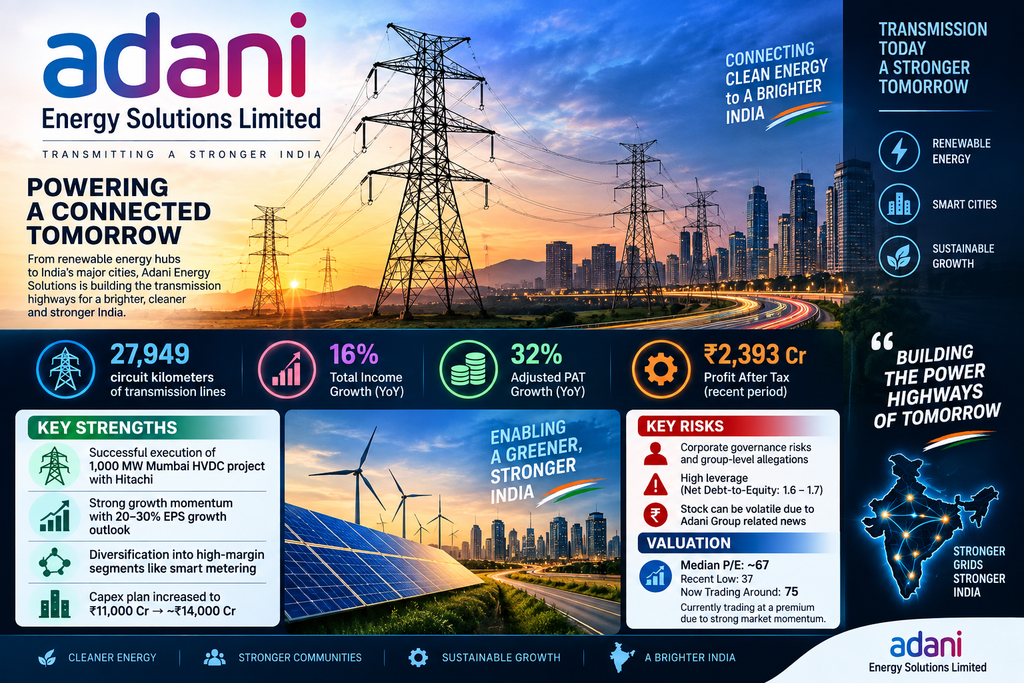
Moving on to the second company, which is a major private-sector competitor: Adani Energy Solutions Limited. Following their successful joint 1,000-megawatt Mumbai HVDC project alongside Hitachi, investors are heavily betting that this exact proof-of-concept can be replicated across multiple Indian metropolitan cities, driving considerable momentum behind the stock price. In terms of scale, Adani operates roughly 27,949 circuit kilometers of transmission lines, making them far smaller than Power Grid’s 1,84,000 kilometers. However, as a privately owned company, they possess the flexibility to diversify rapidly into high-margin segments like massive smart metering projects. This has translated into rapid growth compared to Power Grid; their adjusted PAT grew by 32% and total income rose by 16%, showing an overall EPS growth trailing between 20% to 30% over recent horizons.
Naturally, investor scrutiny regarding corporate governance or broad group-level allegations remains a structural risk, as any negative news impacting the Adani Group can heavily hammer the individual stock, a trend observed in the past. Backed by the national transmission requirements, their capex planning has grown strongly, jumping to 11,000 crores and roughly 14,000 crores. Their profits hit 2,393 crores, demonstrating notable trailing momentum from newly won projects. Forward analyst projections reflect sustained 20% to 30% EPS growth. However, these are highly capital-heavy, leveraged business models; Adani’s net debt-to-equity ratio sat at 1.6 and 1.7, which is structurally high but typical for this sector, similar to Power Grid. Looking at their valuations, the median PE has been around 67; it dropped to a low of 37 recently but has soared back to 75 due to heavy market momentum. Given that the core tailwinds only surfaced recently, short-term valuation baselines indicate the company is currently trading at a premium.
Stock 3: Hitachi Energy India Limited
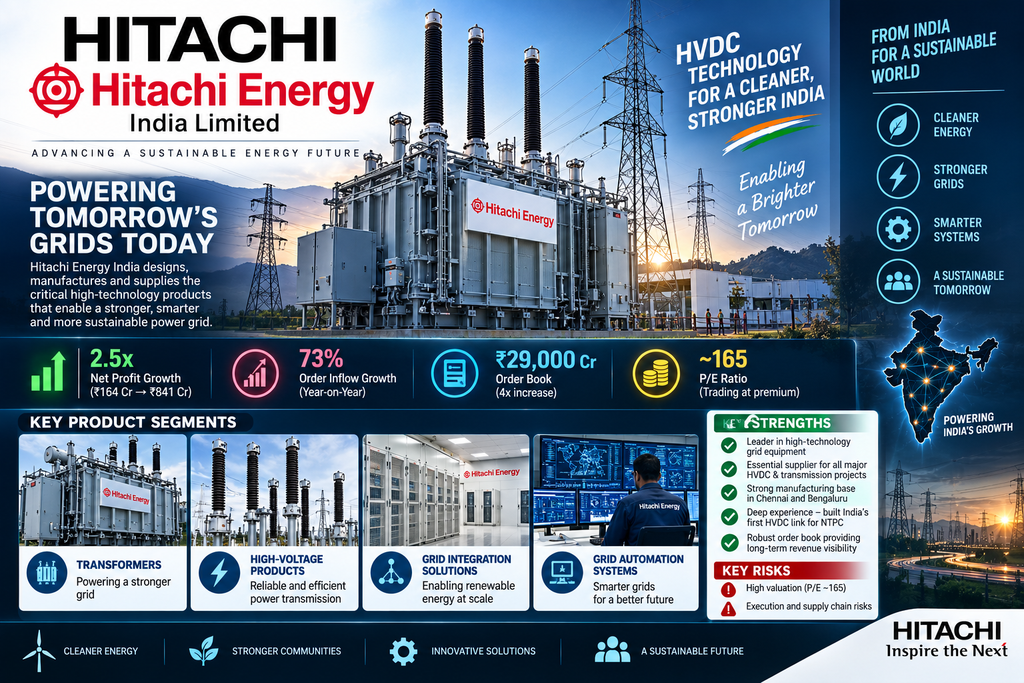
The third company is Hitachi Energy India Limited, which operates under a completely different business model than the first two. They do not manage transmission lines; instead, they manufacture the critical, high-technology hardware and products required for long-distance grid systems. Whether a project belongs to Power Grid or Adani, they require Hitachi’s core equipment, which spans four central product segments: transformers, high-voltage products, grid integration solutions, and grid automation systems. Hitachi has deep roots in India, having built the first HVDC link for NTPC. Crucially, they set up specialized HVDC and power quality factories in Chennai and Bangalore. Savvy investors who spotted that these manufacturing plants would solve the industry’s supply bottlenecks rode a spectacular share price rally.
Their financials reflect this massive surge in profitability: net profits rose from 164 crores to 384 crores, and their last trailing period clocked an incredible 841 crores, marking a 2.5 times expansion. According to their con-calls, their order inflows grew by 73% year-on-year, pushing their order backlog to an all-time high. Looking at their order book trajectory, visibility has expanded nearly fourfold—climbing from 7,500 crores at the start to a massive 29,000 crores, offering long-term revenue safety. However, this visibility comes at an extreme price; the stock trades at a very high PE ratio of roughly 165. While it previously touched levels around 225 to 230 because the market is pricing in explosive multi-year EPS growth, a PE of 160+ remains historically elevated.
Conclusion
A tremendous amount of structural development remains across the HVDC theme. For exact entry and exit parameters, you will need to apply thorough technical analysis. Because of SEBI regulations, I am restricted from displaying the active price charts to avoid offering direct investment advice. I hope this comprehensive structural breakdown of the HVDC ecosystem has taught you something new. If you enjoyed this article, thank you for reading this article hope very useful for you..