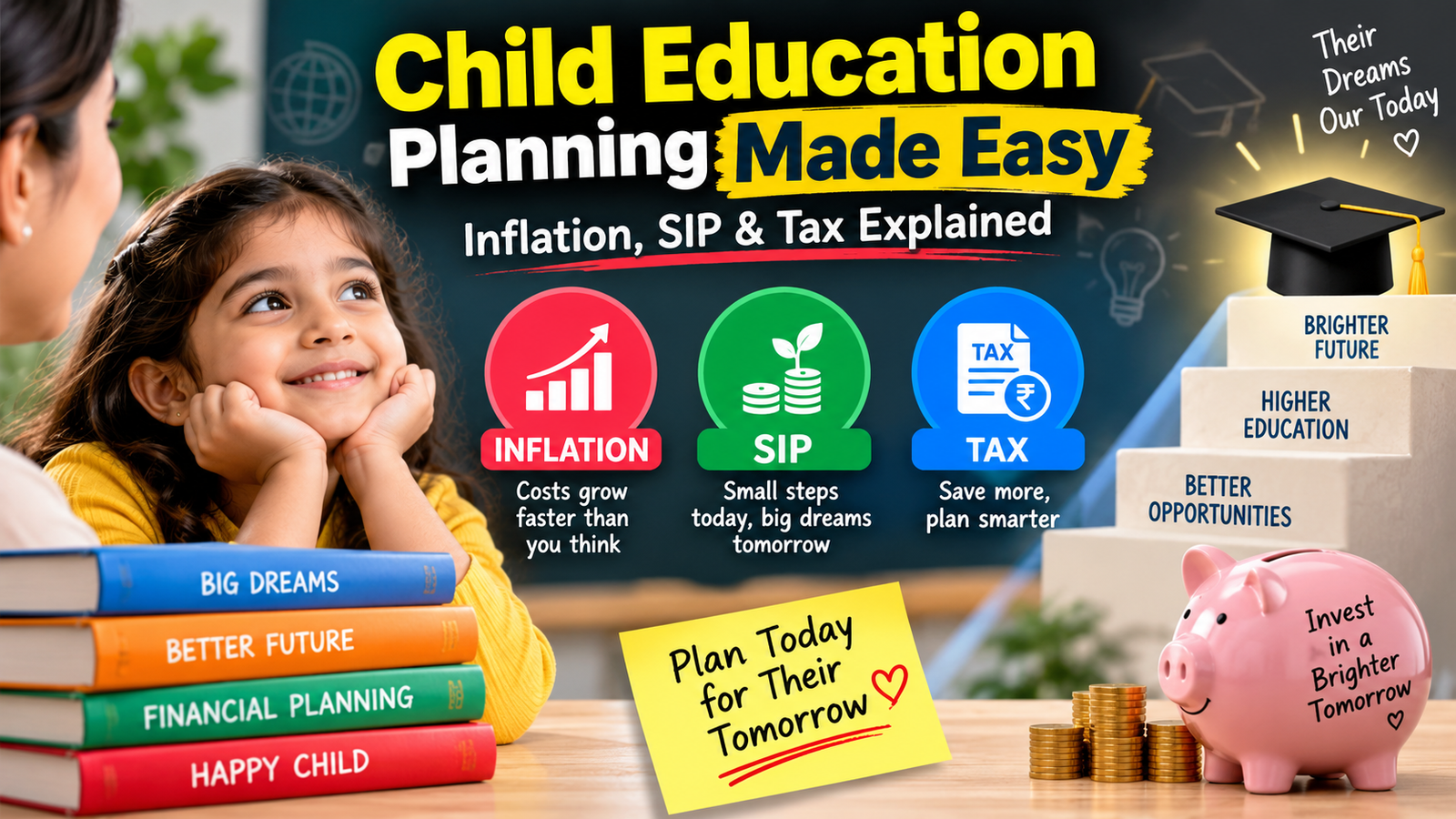
The Reality of Indian School Fees and Education Inflation
What is going on in the Indian school system? Have a look at my screen, and what you will note is Delhi Public School in Delhi for nursery. They were charging 90,000 rupees per year for school fees, and this was in 2019-20. Fast forward 5 years to 2025-26, their fees have gone up from 90,000 rupees to 1 lakh 70,000 rupees. If you do some yearly calculations, it has grown at around an 11% CAGR basis. I mean, portfolios are not growing at an 11% CAGR basis, but the school fees are growing like crazy. It’s not just about Delhi Public School; I picked this name because the data is available. If you go across big cities like Mumbai, Pune, Hyderabad, and Bangalore, the data is not here, but I’m sure it would not be less than 10% of inflation that we are seeing in the Indian schooling system. I really don’t know what is going on here; I really don’t understand why the school fees are growing at such a fast rate in India. Maybe it’s the demand-supply mismatch that’s causing this, but this is absolutely horrific for parents. Mind you, this is just the school fees. If you add other things on top of it, be it the transportation and many other miscellaneous charges that come with schooling, it’s very, very hard to digest these numbers

The Impact on Higher Education Abroad

Now, this is about schooling, but what about graduation or post-graduation? Have a look at this data. What you see here is that the rupee has been depreciating like crazy. Especially in 2025, the rupee became Asia’s worst-performing currency, and it has dropped to 90 rupees per dollar. The immediate impact on Indian students that are studying abroad is that their semester fee went up by almost $15,000. If you do some math, there is a burden of around one lakh extra per semester with this number. Just imagine a student who is studying abroad, or in 2025, all of a sudden the fees have gone up by almost like two or three lakhs that they have to provision for now. You may blame bureaucrats or politicians; you might say that some of these schools are run by politicians or whatnot. You might say that the economy is not doing well or the rupee is depreciating—you can have all that debate. My question to you is: are you planning for your child’s education or not? You may say that you don’t have a child. Okay, if you’re planning for a child in the future, are you planning for your child’s education or not? Of course, you have various other options. You might send your kid to a government (Sarkari) school, or you may send them to low-fee-paying schools; that option is there. You might do homeschooling as well; that option is there. The choice is yours, but if you’re planning for your child’s education, are you rightly budgeting your finances?

The 4-Step Financial Planning Framework
There are three broad mistakes that people are making left, right, and center. I’m going to give you a broad framework of how you plan for your child’s education step by step. I’ll show you some calculations as well, and then we’ll talk about which are the investment tools that you can potentially use for your child’s education. This is a super interesting video; please watch it and share it with your friends and family. If you don’t know me, my name is Rahul Jain. I’m a content creator, I’m an investor, and I’m a SEBI-registered research analyst. Whatever I speak, I’ll back everything by data. With that, if you’re new to my channel, please subscribe to my channel now, and let’s get right into this video.
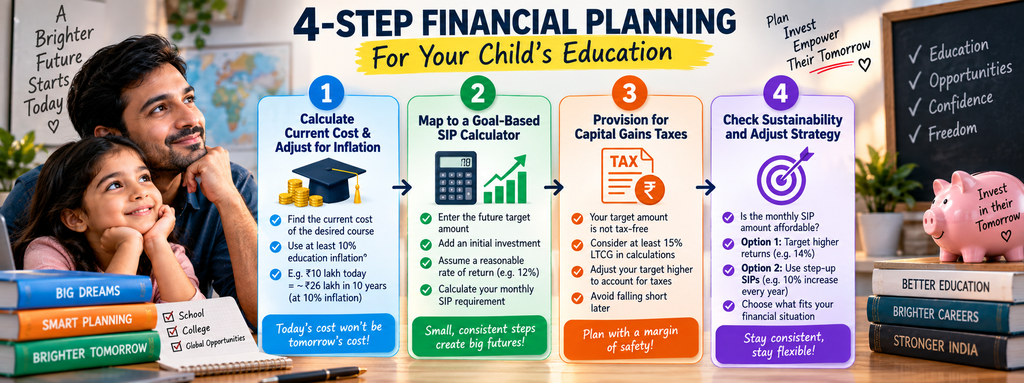
- Step 1: Calculate Current Cost & Adjust for Inflation The first step is to find out what is the current cost of the professional course or the degree that you want your child to pursue. It could be that you want your daughter or your son to become a lawyer, doctor, engineer, or whatever, and whatever is the current cost, you need to gather that. Let’s assume that the current cost is 10 lakh rupees, and your child is going to need this after 10 years because your child might be, let’s say, 5 years or 6 years old. Now, these numbers could be anything, these ages could be anything—I’m giving you a broad framework. So let’s work with 10 lakhs money needed after 10 years. But this 10 lakh would not be 10 lakh after 10 years. We know that because we’ve seen the inflation data. So let’s adjust this for inflation. That will be your step number one, which is to find the current cost and adjust it for inflation. Now, if you go to SEBI’s website, you will find inflation rate adjusted calculations, a very, very simple calculator. Most people do not adjust this number for inflation, and the people who do adjust it for inflation are using a very low inflation rate to adjust this number. They might be using 2%, 3%, or 4%, but please understand that is consumer inflation, that’s not education inflation. So what I would highly recommend is that you put at least a 10% inflation rate, because I showed you in the data in the beginning of the video that the inflation rate in the education sector is 11%, 12%, or 13%. God knows how much it can go up by, therefore at least plan for 10%. So if I do some math here in the calculator, 10 lakhs adjusted for a 10% inflation rate after 10 years means the future cost will be around 26 lakh rupees. So you need to plan for 26 lakh rupees as a minimum.
- Step 2: Map to a Goal-Based SIP Calculator The second step will be that you go to any goal-based SIP calculator. For example, here I am using a goal-based SIP calculator. Now let’s put this target amount here. So we are saying that we need 26 lakh rupees, let’s put 26 lakh rupees here. Initial investment: always put let’s say 1 lakh rupee or two lakh rupee, whatever you can devote from your pocket or from your child’s grandparents. It is very, very important to have some initial number there. Let’s say you need this money after 10 years, assuming that you can generate 12% returns. I’ll talk about returns in a minute, but let’s put an assumption here of 12% returns. Your monthly SIP comes out to be 9,853 rupees for you to hit 26 lakh rupees after 10 years.
- Step 3: Provision for Capital Gains Taxes This leads to the second big mistake: you put a target amount here, but have you provisioned for capital gains taxes or not? Because this 26 lakh rupees is not tax-free. For example, here the tax will be calculated on these estimated returns of 13 lakh 17,000 rupees. On this, the current prevailing rate is 12.5% long-term capital gain. But will this 12.5% long-term capital gain tax remain 12.5% after 10 years? We don’t know that. The government might increase it, the government might decrease it, but the past patterns tell me that the government may increase it. There is a likelihood, and always in finance, you play with a margin of safety. Always keep a margin of safety. What I would recommend here is that you put 15% of long-term capital gain tax in your calculations so that you are not short of money after 10 years. That is very, very important. Therefore, what I’m going to do is adjust this 26 lakhs to let’s say 29 lakh rupees, right? If I target 29 lakh rupees so that I can take care of 15% capital gain taxes, then what is happening here is that I’m getting estimated returns of 14 lakh 62,000 rupees. On this 14 lakh 62,000 rupees, if you calculate 15% of long-term capital gain tax, it comes out to be around 2 lakh 19,000 rupees. If you pay that to the government when you withdraw this money, then you will be left with around 12 lakh 43,000 rupees. Add that into your investment amount of 14 lakh 37,000 rupees, and total you will get roughly 26 lakh 80,000 rupees adjusted for inflation and then adjusted for capital gain taxes. With these calculations, your monthly SIP amount comes out to be around 11,144 rupees. Again, these numbers could be anything; I’m giving you a framework that you can work with.
- Step 4: Check Sustainability and Adjust Strategy Now, the third practical problem that you will face as a parent is that you might say, “Rahul, I can’t afford an 11,000 rupees SIP only for my child’s education. There are other EMIs going out, there are other investment plans that I have, I can’t really have this 11,000 rupees now. What do I do?” There are two options for you. Option number one is that instead of an expected rate of return which is 12%, you will have to target a higher expected rate of return. Now, whether you achieve it or not is a different thing. These calculations are real, but when it comes to increasing your returns, it’s very, very difficult to get higher returns. But at least you need to know what your options are. So therefore, what I’m saying is let’s say instead of 12%, I’m putting it to 14%. What does that do to your monthly SIPs? It gets reduced to 9,600 rupees. Okay, maybe that is workable for you, so you can go and explore those options that are likely to give you a 14% expected rate of return for the next 10 years. Whether you achieve it or not is a secondary thing; you will have to build some safety of margin into that. Option number two—if you don’t want to go for a higher expected rate of return—will be to use step-up SIPs, which is very, very simple. For example, you might say, “Rahul, my SIP amount, the max I can go is 8,500 rupees.” So I’ve done some calculations for you: if you do a step-up of 10% every single year for the next 10 years at 12%, you can still hit your 28 lakh rupees goal for your child’s education.
So again, these are the two options you can play around with depending on your personal circumstances. But broadly, the framework is very, very simple: first find the current cost that your child needs to go into whatever course or educational professional qualification they need to go into, adjust it for inflation, then third will be that you figure out how much of a monthly SIP you would need, take the capital gain taxes out of it, and then finally you look at the SIPs and see whether this is sustainable or not. And again, you have to understand one thing: there is no guarantee that you’re going to hit 12%, 14%, 16%, or 18% returns. These returns are in the future; you cannot predict the future. If you become a disciplined investor, it is possible that you can achieve it.
Evaluating Investment Tools: The Pitfalls of Traditional “Children’s Funds”
Once you’ve done all these calculations, the biggest question is where to invest for a child’s education plan. There are various child-specific education plans or solutions—for example, again, these are examples, not recommendations—like the SBI Children’s Benefit Fund, right? You can go and explore it. The biggest problem in these funds that I find typically is that they come with a lock-in period. The lock-in period, for example, for this one is 5 years. Another example I can give you is HDFC’s Children’s Gift Fund; that also comes with a lock-in period of around 5 years. Now, a lock-in period is good and bad. Good in the sense that at least you will not be tempted to withdraw this money for at least the next 5 years; you will let it compound, right? The bad thing is that, of course, it takes away your flexibility, so it really depends on your individual discipline. But my biggest problem with children’s fund plans is that they are typically hybrid mutual funds. For example, the SBI fund is tracking a benchmark which is hybrid 35-65. Now, these are not fully equity-based mutual funds, and their returns are likely to be lower. It is absolutely possible that they might not be able to even beat the education inflation rate that we talked about, right, which is around 10% or 11%? So in my view, when it comes to investing for children’s education planning, as long as you have a longer time horizon of at least more than 5 years, equity investing makes a lot of sense.
Three Investment Alternatives Based on Target Returns
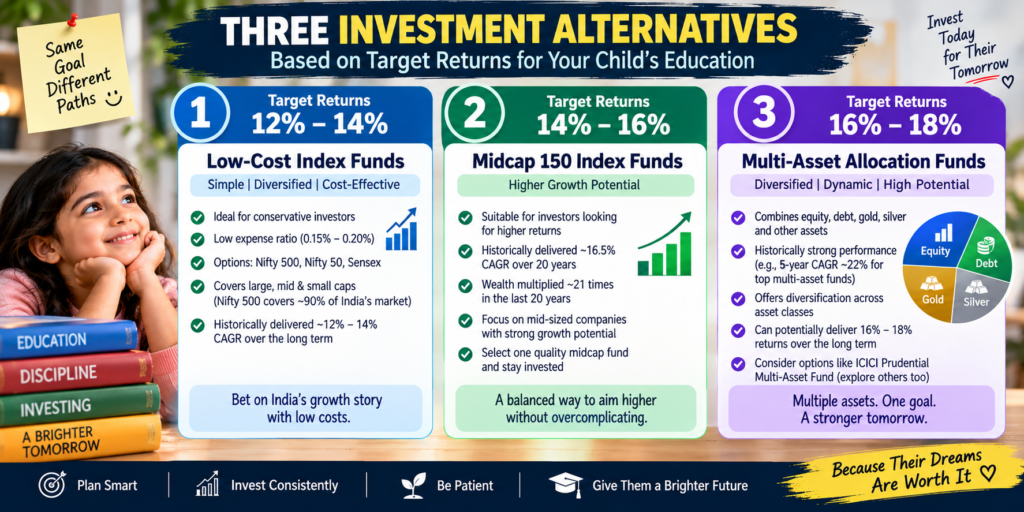
So which are the equity investment options that you can consider? Primarily, there are three scenarios that you may fall into depending on your expected rate of return. We’ll go into three main scenarios. The first scenario is let’s say your return expectation is 12 to 14% on a CAGR basis. Second is that your return expectations are slightly higher, 14 to 16% CAGR basis. And finally, you have a returns expectation of around 16 to 18% CAGR basis. More than 18%, I wouldn’t say that you plan for that; if you’re planning for that, it is a recipe for disaster. Less than 12%, the reason I have not considered it is that it is not likely to beat the education inflation post-capital gain taxes, right? Therefore, I’m going with these three scenarios here.