

Hi friends, my name is srikrishna, and I’m a I want to start this video by looking at a specific stock chart where the company’s price has gone up by almost 85% in just one year. You might think this huge jump was caused by high earnings growth or really attractive valuations when the stock started moving up. However, looking closer reveals that foreign institutional investors (FIIs) started buying shares of this company early on. When FIIs or domestic institutional investors (DIIs) start buying into a company, they buy in bulk, and that is generally what causes stock prices to experience massive rallies.

The Strategy: Spotting Interest Early
An important observation is that early on, there was only a tiny, incremental interest by FIIs as holdings slowly crept up. Until that time, there was no major movement in the stock price. But the moment FIIs accelerated their accumulation, the stock began to experience massive rallies. The point is simple: if you can find these stocks at an early stage when FIIs or DIIs have just started showing a tiny bit of interest, you can get in before they finish building their huge positions. Most retail investors only look for these names after the big institutions have already finished buying. Our goal is to pinpoint them early.
Building the TickerTape Screener
To find such companies, I am going to show you how to live-build a custom stock screener using TickerTape. There are currently 17 to 20 companies that qualify under this strategy, but remember that the exact stock names are not what matters most because this data changes almost daily. Please focus on learning the concept and building the screener along with me. None of these stocks are financial recommendations; they are strictly for educational purposes.
To start, we head over to TickerTape, select the Indian stock screener, and clear out default metrics like close price, PE ratio, and one-month returns. Usually, I filter for companies with a market cap over 10,000 or 15,000 crores, but for this specific strategy, we will not exclude lower market caps. If FIIs and DIIs are actively buying a smaller company, it means there is something uniquely attractive about it that we need to investigate.
Setting up the Core Filter Criteria
- FII Holding Change (3 Months): We look for companies where FIIs have increased their holding over the last 3 months. We set a minimum boundary of 0.50% and a maximum cap of 3.0%. This target zone captures companies experiencing fresh institutional interest without choosing ones where the heavy buying is already finished. This initial filter narrows our list down to roughly 253 companies.
- Total Foreign Institutional Holding: We don’t want companies where the overall foreign holding is already massive, because that leaves less room for future accumulation. Instead, we target companies where current total foreign holding rests between 1% and 15%. This limits the list further down to around 198 stocks.
- DII Holding Change & Total Domestic Holding: We apply identical logic to domestic institutional investors. We screen for a 3-month DII holding increase between 0.50% and 3.0%, paired with an overall domestic institutional holding cap of 1% to 15%. This leaves us with a highly refined list of just 17 companies where both institutional segments are simultaneously buying in.
Layering Valuations and Price Movement
Next, we layer in additional parameters for deep-dive analysis, specifically focusing on valuations and recent price movements. We add filters for the PE ratio premium versus the sub-sector and the PB (Price to Book) ratio premium versus the sub-sector. Note that these premium metrics require a TickerTape Pro subscription. We won’t automatically exclude companies just because they look slightly overvalued, as institutional buying often indicates sustainable business tailwinds. However, sorting the list by lowest-to-highest PE premium helps us easily spot value plays trading at a relative discount.
Finally, we include price tracking metrics: the percentage away from the 52-week high and the 52-week low. Ideally, you want to avoid buying a stock that has extended too far and is sitting right at its peak.
Case Study 1: JSW Cement Limited
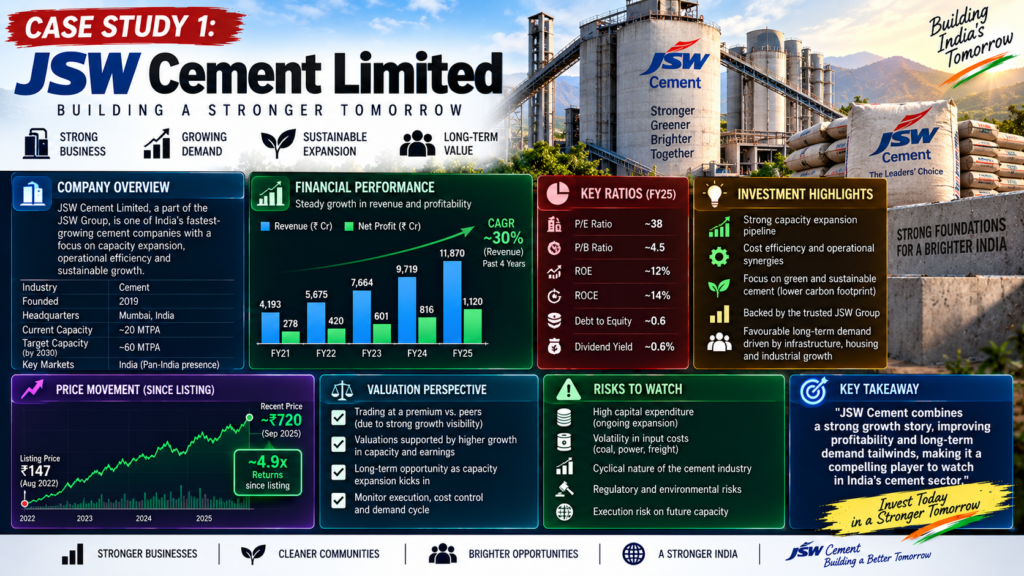
Looking at JSW Cement Limited as an example, the screener shows it trading at a noticeable discount from a PE perspective, though it sits at a premium on a PB basis. Its current stock price is about 21% below its 52-week high and roughly 24% above its 52-week low, showing it isn’t overextended. Checking its individual holding structure reveals that FIIs were selling down their positions previously, but suddenly turned around and aggressively accumulated shares in the recent quarter.
A sentiment and growth driver analysis explains why: the company is undergoing massive regional expansions, entering northern markets, and recently commissioned an integrated Nagpur plant. Management aims to scale capacity significantly over the next few years. Operationally, the broader cement industry grew at 8%, but this company outpaced it at 12% year-on-year. Financially, after posting recent losses, its profits have consistently rebounded at a rapid pace, making it an interesting turnaround candidate.
Case Study 2: Jammu & Kashmir Bank Limited
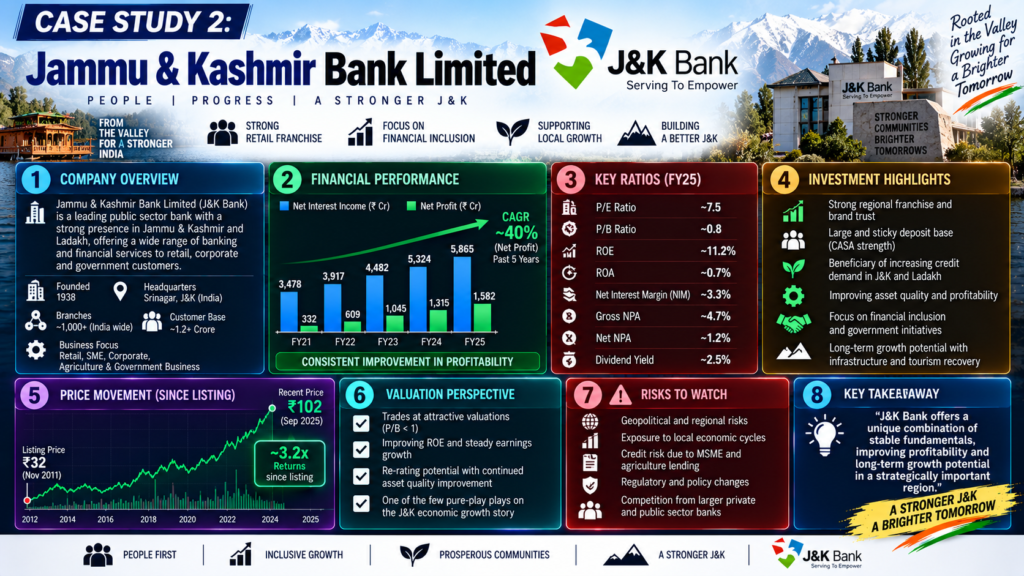
Skipping over names like Satin Credit Networks because it is too close to its 52-week high, we find Jammu & Kashmir Bank Limited, which sits roughly 29% below its 52-week peak. Unlike JSW Cement, FIIs have been consistently and continuously increasing their ownership stake here over consecutive quarters. Looking at the financials reveals excellent EPS growth over the last three years.
Reviewing their investor presentations reveals a remarkable turnaround story: net profit has expanded at a 40% CAGR over the last few years, a growth rate very few banks match. Furthermore, while most private banks are currently struggling with low deposits and high credit-to-deposit (CD) ratios, J&K Bank boasts an advantageous position where deposits make up 57% of their mix against a loan book of only 43%. This massive liquidity buffer gives them immense runway to hand out profitable loans moving forward.
Their fundamental asset quality and profitability metrics have dramatically improved, with Return on Assets (ROA) and Return on Equity (ROE) scaling upward. Gross Non-Performing Assets (NPAs) plummeted from a staggering 10.97% down to 2.50%, while Net NPAs dropped to a clean 0.64%. Though heavily concentrated inside Jammu & Kashmir with 878 local branches compared to 139 outside, their primary growth is now coming from geographic expansion. Their loan books grew by 28% outside their home state compared to 9.5% inside, proving they have an entire country left to penetrate. This deep fundamental improvement is precisely why FIIs are buying continuously. However, it isn’t without risk; their latest quarterly profits dipped, meaning volatile periods can still pull the stock down.
Summary and Call to Action
With these two case studies, we have only scratched the surface. I haven’t dove deeply into key areas like free cash flows or fundamental valuation models, meaning you still must execute full due diligence. Use this screener framework to scan the 17 qualifying companies, run your own research, and decide what aligns with your portfolio strategy.