
Hi friends, let me ask you a question. If you were to invest 10 lakh rupees in the Indian stock market for 2030, where would you invest your money? Pause this video for one second and let me know your answer in the comments. If your viewpoint is that you know what, Indian stock markets are dead because for the last couple of years no returns have come, you’re entitled to that view. When it comes to my viewpoint, I believe that there are pockets in the Indian stock market that are growing at a very, very good growth rate. In this video, I’m going to present to you mind-boggling data analysis. We’ll bring you some examples of companies that are doing really well, mutual funds, smallcases, index funds, and bring you a lot of information in this particular video to tell you exactly where I would put my 10 lakh rupees for 2030. If you’re new to my channel, don’t forget to subscribe. Watch this content for a few minutes and if you learn something new, become a lifelong.

Investment Theme 1: The Data Center Boom (30% Allocation)
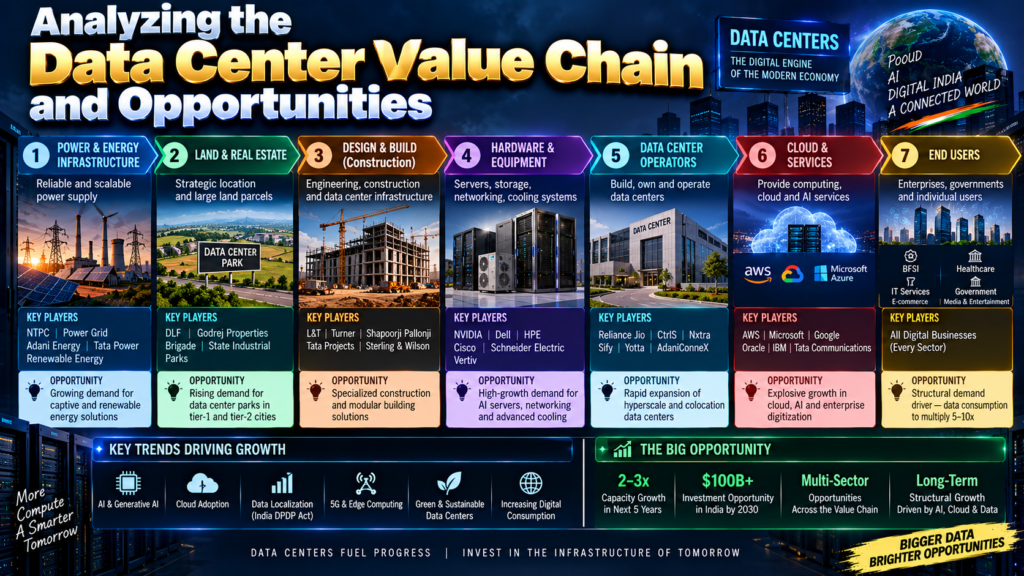
I want to start with my first investment out of this 10 lakh rupees. Around 30%, which is around three lakh rupees, I’m likely to deploy in the data center theme. Allow me 2 to 3 minutes of time; you’re going to learn a lot about data centers. On the data center theme, I already created these two videos on my channel a few months back, but there are some recent updates—massive updates—that I want to present to you. The first big update is that just two days back, our Commerce Minister Mr. Piyush Goyal said that India is the best location for data centers, and he’s talking about a $200 billion opportunity. In my previous video, I talked about around a $70 billion opportunity, but you know what, the minister is now talking about a $200 billion opportunity. Now, a lot of people will say that you know what, this is not good for India because data centers need a lot of water, they need electricity, etc., and we are already thin on these good resources. Why are we doing that? That viewpoint is also valid, but I’m looking at this purely from an investment lens. So, this is one big update that came out, and the second big update that you need to know and that I just want you to remember is that in budget 2026, the Indian government announced a tax holiday for data centers up to 2047. Meaning, any foreign company that sets up a data center in India is going to be free from taxes up until 2047. So that’s like 20 years out from here on. And just one month back, the Indian government also proposed very, very easy compliance for foreign firms to set up data centers in India. Right? So, a lot of tailwind is going into this particular theme from the Indian government itself.

Analyzing the Data Center Value Chain and Opportunities
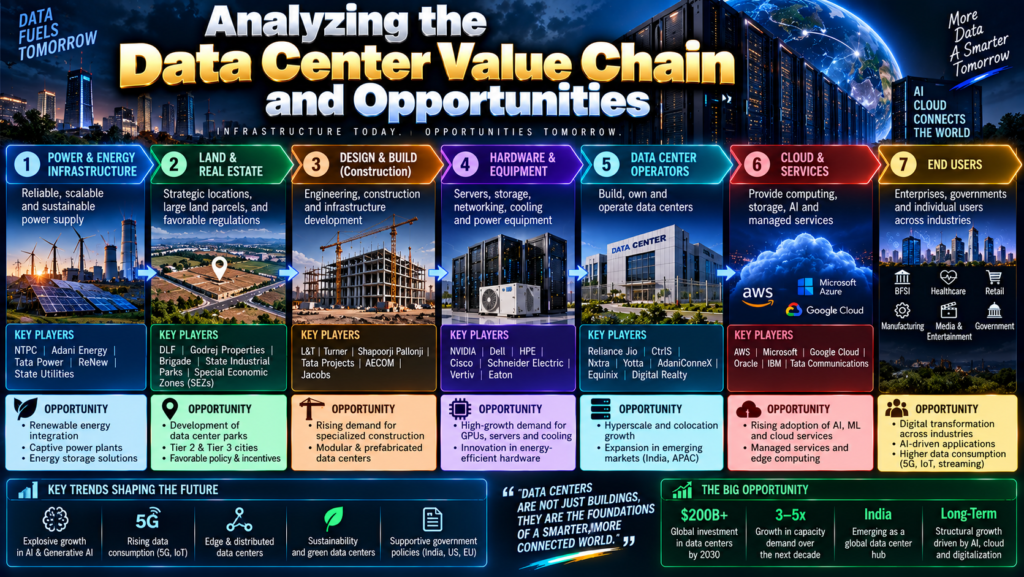
But the bigger question is, at what growth rate is the data center industry likely to grow? Here is some data for you. If you look at the current data, global data center capacity is at 100 gigawatts, and it’s likely to double to 200 gigawatts by 2030—so around a 14% CAGR globally if you look at it. But if you look at Indian capacity, it is at around 1.8 gigawatts only as of now, and by 2030 it is forecasted to grow to around 7 gigawatts. So it’s around 3.5 times growth, and that comes out to be around a 35% CAGR growth rate. Now, 35% CAGR growth in terms of investments in data centers and in terms of capacity, etc., could lead to earnings in companies’ stocks, right? And if that translates to the stock prices, and if I look at, I don’t know, a 30% CAGR growth rate in stock prices, then it’s like almost doubling your money in two years. That is the sort of potential this theme has. Of course, it has a lot of risks as well, I’m not denying that, but the fact is that it is a very, very fast-growing sector.
Now your natural question will be, “Rahul, if that’s the case, where are the opportunities in the data center theme?” Allow me two to three minutes of time, and I’ll walk you through a few things that you need to understand. First of all, if you look at the data center value chain end-to-end, there are eight buckets where you can look at companies and explore them. Starting from companies that are into land and real estate, likes of Anant Raj for example, right? Building an infrastructure, power infrastructure, cooling infrastructure, connectivity infrastructure, optical fibers—two companies in particular are doing phenomenally well, but be careful about the valuations again. I’m not naming these companies here as it doesn’t really make much sense; I really want you to understand this holistic picture. IT infrastructure, GPUs, etc., servers, racks, etc., data center operations that the companies are managing, and end users that are actually using these AIs. So there are eight broad categories where you can look at companies. Now, there are a few companies in India that are into this particular theme, but very few companies are 100% into data centers. I built a list of around 15 companies; none of these are recommendations here, but you see the list here and the category that they belong to. Some of these are into power, some of these are into cooling, but please understand only very few companies—one, two, or three listed companies—have 100% of their revenues coming from data centers. The majority of these companies have either not disclosed how much of their revenues are coming from data centers, or for some that have disclosed as of now, only a very minor portion of their revenues are coming from data centers. So you need to be really, really careful in picking these companies, keeping in mind that not every company doing cooling, for example, is bringing its revenue from data centers—a very, very important point that I’m making here. But these 15 companies are possibly a good start for you to begin having a look at. Again, they are not recommendations here.
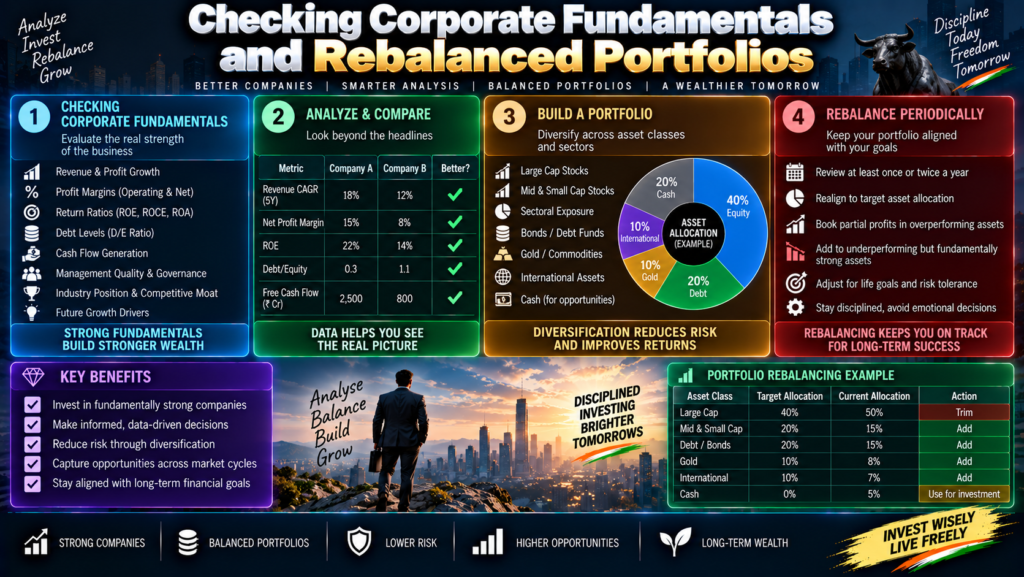
Checking Corporate Fundamentals and Rebalanced Portfolios
In fact, I looked at these 15 companies and looked at what their PAT growth rate was in Q1 FY27 just to see whether these companies are actually showing some growth or not. So let me present to you that data as well. What you see on my screen is, as per Q1 FY27, the PAT growth rate and the topline growth rate as well. Companies like Anant Raj are doing around an 18 to 20% PAT growth rate. Techno Electric has gone negative for some reason; I’m not sure what has happened there. E2E Networks has turned profitable. Cummins India, you can check out their results as well. Out of some of these companies, Hitachi Energy has been doing phenomenally well, but please understand, not 100% of their revenues are coming from data centers; they’re also into transmission and distribution, etc. Again, I’ve covered that in my energy theme video. You can see some of these companies and how they are doing. Sterlite Technologies, again a company into optical fibers, has done phenomenally well in terms of their PAT growth rate, etc. Likewise, you can see these companies and how much PAT growth they are delivering. Because it’s important that we understand whether all of these policy changes that the Indian government has made are actually flowing into these companies’ bottom lines or not. You cannot just pick a company just because it is operating in the data center space; we have to look at the fundamentals. So again, go and look at these companies. I’m not going to go and talk about each of these companies here because the video will get really, really lengthy. Hopefully you get the point that there are a lot of companies out there, and I’ve not covered all of those companies here in this particular list. I just found this list and built it to map into the data center theme as of now.
Now, if you don’t want to pick direct stocks, as of now there are no mutual funds, there are no index funds, and there are no ETFs that are catering to the data center theme. However, there are smallcases built around the data center theme. For example, if you go to the smallcase platform, you’ll find a few smallcases on the data center theme in particular. You can see a few smallcases on my screen now. These smallcases are built by SEBI-registered professionals. Let me quickly show you one example of smallcases on the data center theme. For example, if you look at this one, they are focusing on those companies and stocks which are into computing, cloud, power and cooling, and infra. So this could be one smallcase that you can go and explore. Within a smallcase, you will have around 10 to 15 stocks. They are much more concentrated than mutual funds, because mutual funds might have around 30, 40, 50, 60, or 70 stocks, but smallcases in general are quite concentrated because they try to give you concentrated portfolios. Now, the important aspect of any smallcase is how frequently they get rebalanced. For example, if you look at this one, it is getting rebalanced almost on a quarterly basis. For instance, here on the 24th of April, two stocks were added into the smallcase. On the 4th of May, two stocks were removed. And on the 4th of August, six stocks were added and four stocks were removed. So this is called the rebalancing of smallcases, and this activity is extremely important for any smallcase. It is performed by the fund manager or the SEBI-registered professional that is managing that particular smallcase. So you don’t need to manage any of that; the smallcase manager or the fund manager is doing all this for you automatically. Now, these smallcases are not free; they come on a subscription basis. For example, for this smallcase, the charges are around 8,750 per year. Meaning, it doesn’t matter whether you invest 10,000 rupees, 1 lakh, 10 lakhs, 1 crore, or 10 crores—the subscription charges will be 8,750 rupees for 1 year. This is much like the expense ratio in mutual funds, but there in mutual funds, it really depends on the money, right? The expense ratio gets applied to your investment amount. Here, that is not the case, and you can in fact do some SIPs as well if you were to. So if you want to invest in data center-related smallcases, I’ve given you the link in the description and in the pinned comment; you can go and explore these smallcases. So this is theme number one where I’m likely to split 30% of my money from the 10 lakh rupees for 2030 goals, because I see that there is likely to be growth here.
Investment Theme 2: Capital Markets and Wealth Generation (50% Allocation)
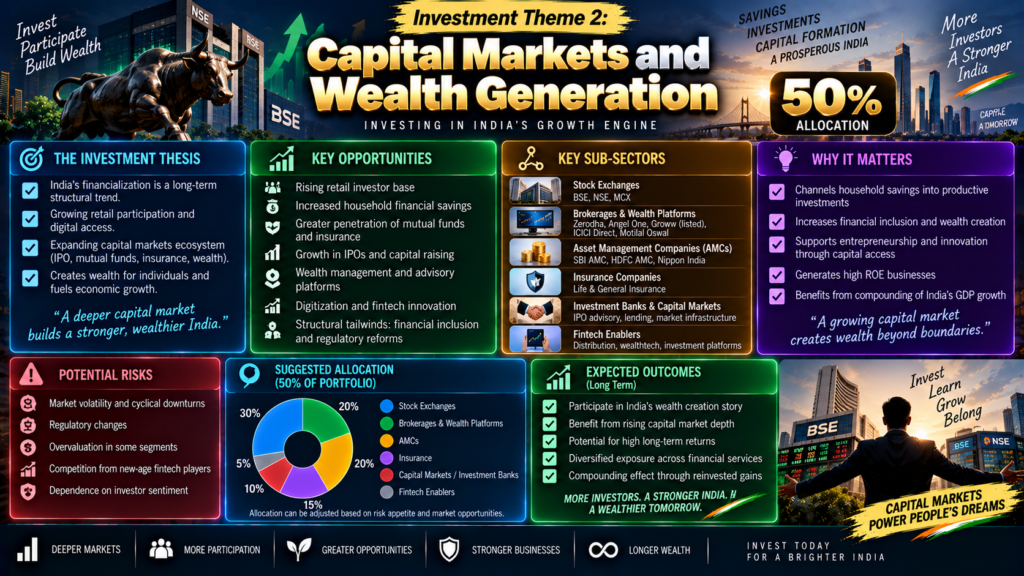
Coming to the second investment, I’m going to put 50% of my money out of the 10 lakh—5 lakh rupees I’m going to put into this second bucket. And this is the capital market and wealth generation theme. Have a look at my screen, and what you will see is that I’ve taken around 10 sample companies here and I’ve looked at their Q1 FY27 growth rate. What do you see here? Companies like Groww have a 94% PAT growth rate in Q1 FY27, MCX has 103%, BSE, Nippon AMC—again, you can see this list of companies. What you will note as a common pattern is that these companies are growing at a very, very healthy PAT growth rate. Now the question is, why is this happening? Why is there so much growth in these companies? The answer lies in a couple of points. One is if you look at how Indians are now moving their money into the market—stock market, mutual funds, equities, direct stocks. For example, here in FY12, if you see, around 2% of household savings used to be in mutual funds, equities, etc. Come to FY24, this 2% has gone to 16%. Meaning, if somebody owns 100 rupees of assets, 16 rupees is now in mutual funds and equities. If you go to the FY33 forecast or projection, it is likely to go up to 24%. So this theme is likely to do well in the future. Why? Because Indians are likely to put more and more money into mutual funds, direct stocks, smallcases, and ETFs. This is because they want to generate better returns for themselves; they want to build better wealth, higher wealth for themselves, and the potential in this scheme is huge. For example, if you look at the population of 148 crores, as of now only 5.5 crore people are investing in mutual funds and only 12 crore people are investing in direct stocks. There is still such a huge population that is yet to go into the capital markets and wealth generation theme, so the runway is very, very long from here on. If you’re a long-term investor, you’ve got to think about the capital market and wealth generation theme. I’ve been saying this for a number of years now; at least for the past two years, I’ve been talking about this theme. People who have been listening to me and have been investing in this particular theme would have gotten very, very good results. Of course, it depends on which type of stocks you pick up, etc.
Structural Tailwinds and the Wealth Management Sector
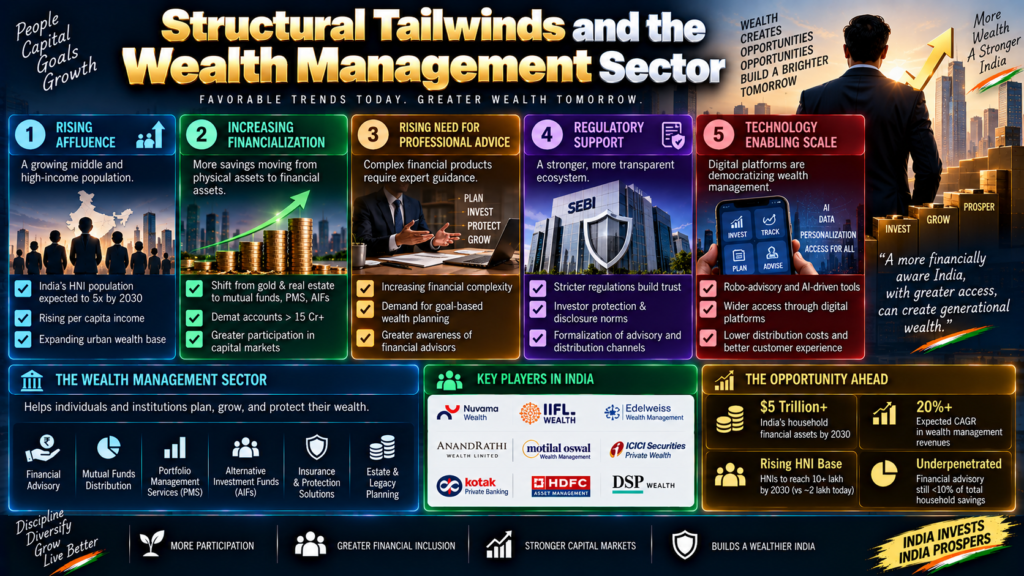
For example, here, if I were to classify this into let’s say broad seven segments that you can see on my screen, there are businesses like Groww and Angel One—they are like brokers, etc., digital platforms, asset management companies (AMCs), and then wealth management companies. This third segment you see, I feel like this is going to be the fastest-growing segment, where HNIs and ultra-HNIs—these people’s wealth—is being managed by companies like Nuvama, Anand Rathi, and 361 ONE. Again, please don’t take any of these as recommendations, but I’m giving you flavors of these companies that are operating in this particular segment. You see, the majority of these themes that you see are generating recurring revenues because AMCs, for example, are continuously getting yearly fees from mutual fund SIPs. Likewise, wealth management companies are generating yearly fees from their clients, so these are recurring revenue and profit-generating themes that you can see. Again, you can go and explore these themes. But if you were to ask me for only one segment that I should pick out of the seven, I’m going to go to wealth management; I think that is going to give you a huge opportunity. In the diversified capital market, there are a few other companies as well that you can also explore to delimit your risk because they are diversified and are into many things. This is the way you can go and look at these companies.
Right, if you don’t want to pick direct stocks, then there is the Nifty Capital Market Index; you can go and explore that index. For example, in this index, there are top 10 companies that you can see as of now: BSE, MCX, and it’s a mix of your exchanges, your brokers, and your AMC companies, so you’ve got everything in the index, but you get index returns in such cases. And if you look at the index returns, you can see my screen here: as of 31st of July, 1-year returns have been really good at 23%, 3 years at 55%, and 5 years at 28%. So this theme has been already bubbling, and I don’t know why people keep saying that Indian stock markets are dead, because themes like these are actually making good money. I mean, this is the data that you can see yourself. In the month of March, when the US-Iran tension started, some of these companies were down by 30 to 40% because of that market crash, and that was a very, very good opportunity for people who understand that these themes have inherent tailwinds behind them. They’re not going anywhere very soon. Of course, short-term risks like cash and transactions dropping, etc., remain; they are all short-term and are not structural risks. Anyways, coming back to mutual funds, index funds, and ETFs, you can see on my screen there are a few index funds that you can go and explore—none of these are recommendations. Tata Nifty is there, Motilal is there, Axis Nifty is there, Groww Nifty is there. There are ETFs as well; if you’re an ETF investor, you can go and explore that. There are smallcases as well on the capital market theme you can go and explore; those are highly concentrated. In concentrated themes like smallcases, your risk is slightly higher, and maybe your returns are also slightly higher. Again, you can go and explore these themes, but don’t sit idle there and just think about Nifty; think beyond Nifty. That’s all I want to convey on this particular one. I’m going to put around 50% of my money if I were to dissect 10 lakh rupees—five lakh goes into this particular theme because I feel this is a very, very buzzing theme and likely to remain so.
Investment Theme 3: The Energy Theme in India (20% Allocation),
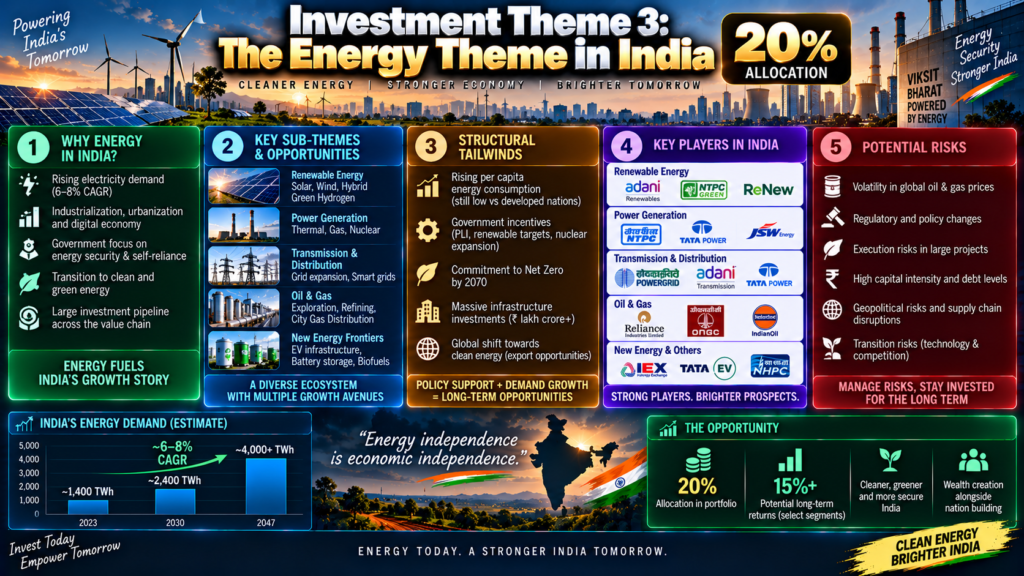
Now let’s move to number three, which is where my remaining 20% (2 lakh rupees) is going to go. Hope you’re liking this video so far. If you like this video, let me know in the comments with a simple “thank you,” and hit that subscribe button as well. With that, let’s go to the third theme. The third theme is the energy theme in India. I created this video very, very recently on my Hindi channel. If you have not watched it, go to my Hindi channel and you will learn a lot about this theme. I’ve gone into a lot of detail in that particular video, but very quickly I’m going to give you quick updates. Number one is that the International Energy Agency is saying that India is likely to see around $170 billion of money flowing into the energy theme in just one single year—that is 2026. Can you imagine $170 billion? I did some maths, and it comes out to be around 16 lakh crore worth of money in just one single year. And I looked at some of these companies; for example, on your screen you will see Adani Energy Solutions, Hitachi Energy India, Oil India, Siemens, Premier Energies, Adani Power, and NTPC. You see how much PAT growth they have reported in Q1 FY27: 130%, 123%, 91%, 67%, 53%. Why? Because all of this money that is flowing is going into the PAT or bottom line of these companies, directly making an impact. Now, I’m not saying the valuations of some of these companies are not huge; it is absolutely mind-boggling. But that’s not the point. The point is that growth is there, and whenever there is a dip in the market because of whatever correction is happening, then these opportunities become really, really good. And this theme is likely to sustain for at least another 10 to 15 years because of many reasons that I have explained in my Hindi video. You can go and watch that.
Exploring the Nifty Energy Index and Summary
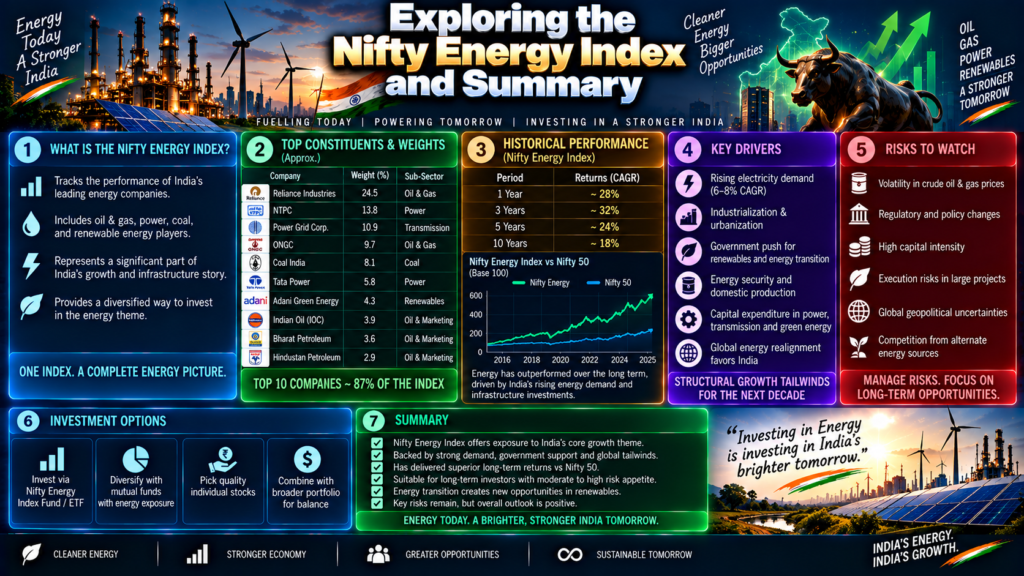
But if you don’t want to pick any companies particularly and are not good at picking stocks, then in that case, the Nifty Energy Index is your best friend. This index has around 51% coming from oil, gas, and consumable fuels, power at 24%, and capital goods at 23%. And if you look at this Nifty Energy Index’s last 5 years’ returns, you can see them here. Since inception, you can see the returns here as well, and it has comfortably beaten Nifty 50. Here is the data you can see yourself: 25 years, 20 years, 15 years, 10 years, 7 years, 5 years—you look at any time horizon, it has beaten Nifty 50 comfortably in the past as well. So you can see this purple line here; this is what the performance of Nifty Energy has been in the past, and it is likely to sustain in the future because of the huge investments going into this particular sector here. Top 10 companies you can see on my screen in this particular index: Reliance Industries, Oil and Natural Gas, etc. I’m going to give you the link to this video as well in the description and in the pinned comment so that you can go and explore this theme. Go and watch that Hindi video; I’ve talked about index funds, mutual funds, and ETFs as well there. There are smallcases as well; if you only want a concentrated portfolio, then there are smallcases as well you can go and explore.
Conclusion and Risks Warning
Again, this video is getting really, really long. I wanted to cover the top three themes where I’m likely to put my money. 20% can go into energy. Why only 20% in energy? The main thing is because these are heavy capex-related and heavily regulated by Indian government policies as well. Tomorrow, if something else changes in terms of power, then things might fall. So these are the things that you need to understand. But hopefully, I’ve given you a lot of information that you can work with and decide for yourself where you would like to put your money—whether the Indian stock market or no Indian stock market is, of course, your choice.