
Goldman Sachs 2026 Outlook and the Need to Diversify
There is a very interesting report published by Goldman Sachs recently talking about the market outlook. What they are saying is that we are going to see a broadening of the current bull market. Geography-wise, they are referring to the US market. From a sector perspective, they are looking at AI stocks, and from a factor perspective, they are looking at growth stocks. Growth stocks—specifically AI stocks in the US—had a massive bull run. However, this new report highlights that the best strategy is going to be diversification. The summary explicitly advises to diversify across regions instead of depending on just one particular area like the US, diversify across factors by choosing both growth and value, and diversify across sectors instead of sticking strictly to one sector like AI. A few days back on my channel, I created a video sharing a similar sentiment, mentioning that I am personally going to deploy around a quarter of my portfolio into global markets. When investing globally, there are a few routes you can take: direct stocks listed on US or UK exchanges, Indian mutual funds, GIFT City-based mutual funds, or truly global mutual funds and ETFs. The main issue with Indian mutual funds is that due to RBI limitations, many are not taking fresh investments into global portfolios, which means we have to look closely at other options.

Option 1: GIFT City-Based Mutual Funds (DSP Global Equity Fund)

The first option available from GIFT City is the DSP Global Equity Fund, which can be accessed through platforms like Vested. More funds are likely to come out of GIFT City in the future, but looking at this specific fund’s geographical allocation, it allocates roughly 30% to the United States, 25% to the EU, 20% to China, 6% to South Korea, and 14% to others. According to their prospectus, their thesis dictates a minimum 65% allocation into global equities. Their top holdings include brands like Nintendo, Puma, Universal Music Group, Airbnb, and BMW. Notably, they do not hold AI stocks because their underlying theme is to pick quality companies that are less prone to rapid technological disruption. The fund tracks the MSCI ACWI (All Country World Index), covering 23 developed and 24 emerging markets. Looking at the historical performance of this index, it returned around 18% in the short term, 19% over a medium timeframe, and 12.49% over a longer period, though past performance doesn’t guarantee future returns. Out of the index’s 3,000 stocks, the fund focuses on 400 to 450 large companies with a market cap over $30 billion. They look for companies consistently generating 10% to 12% in owner’s earnings (derived from annual profit growth plus shareholder payouts via dividends and buybacks) and buy them at a 30% to 40% discount to their estimated fair value.
Regarding the taxation of this GIFT City fund, you do not need to pay individual capital gains taxes on your profits. However, this does not mean it is completely tax-free; the fund itself handles and pays the tax liabilities. When the fund sells a stock held for the short term, it pays a high tax rate of 42% on the gains. For long-term holdings, the fund pays around 14.95%. While this structural setup makes return filing simpler for investors since taxes aren’t deducted directly from your final payout, it is still factored into the fund. On the negative side, the minimum investment is quite high at $5,000, which works out to roughly 4,50,000 rupees given average exchange rates, potentially ruling out a lot of retail investors. Furthermore, the expense ratio is on the higher side at 1.75%.
Option 2: Truly Global Mutual Funds (Fidelity Global Technology Fund)

If you are still keen on global technology exposure, another option is a truly global mutual fund based out of Luxembourg, such as the Fidelity Global Technology Fund. This fund features a heavy US tilt at around 59%, alongside allocations to Taiwan (9.82%), the Netherlands, China, South Korea, Sweden, France, and Japan. Its highest single asset allocation is TSMC at 9.26%, followed by large global corporations like Apple, Microsoft, Amazon, Google, Salesforce, and Marvell Technology. The fund is well-established and manages $28 billion in assets under management (AUM) with an expense ratio of 1.89%. Driven by the massive tech boom, its historical returns stand at 22% for the short term, 98% over a medium timeframe, and 510% over a long horizon. The fund benchmarks its returns against the MSCI ACWI Information Technology Index. An interesting performance trait is its volatility; during market drawdowns where the index fell heavily, this fund proved to be less volatile and did not crash as deeply as the index. Conversely, in highly positive years, it slightly underperformed the index. This indicates it is a lower-volatility option for long-term horizons, though investors should always remember that global funds require a long-term commitment and can fluctuate based on global events.
Option 3: China-Focused Global Funds
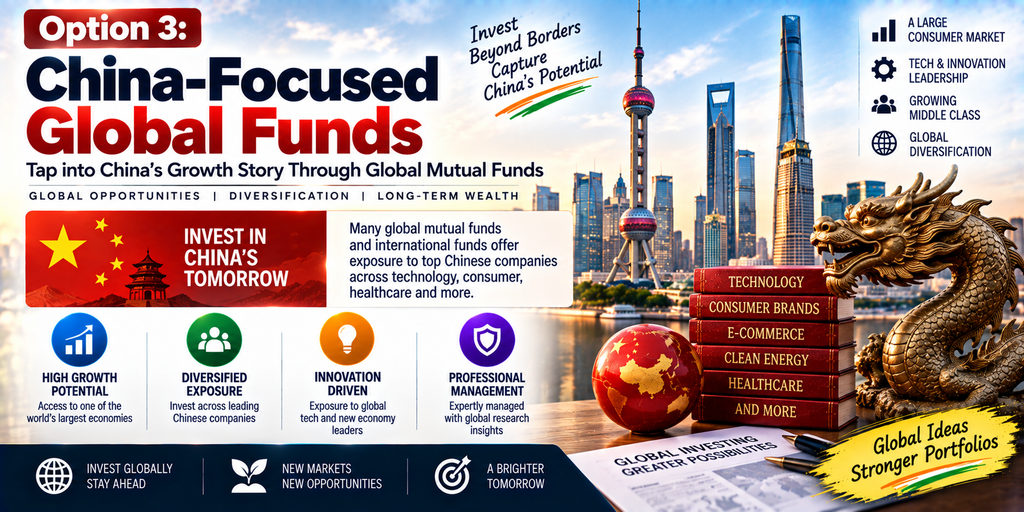
For investors who feel bullish about the Chinese market, there is the Fidelity International China Focus Fund. The Chinese market has performed strongly over a recent stretch, yielding around 25% returns. This fund allocates 82% of its geographic profile directly to China, 7.99% to Hong Kong, 5.72% to the Netherlands, and a very limited 1.06% to the United States. Its holdings consist primarily of Chinese tech giants like Tencent and Alibaba. The fund commands an AUM of $2.5 billion and carries an expense ratio of 1.91%. Looking closely at its historical return data against its benchmark index, it has managed to beat the index handsomely over a multi-year period. While there are Indian mutual funds that offer exposure to Chinese stocks as well, this global fund remains a distinct option to explore for long-term systematic investment plans (SIP).
Option 4: European Market Funds

Turning towards the European theater, searching for European equities reveals options like BlackRock’s European Equity Fund. Because the European markets have not witnessed massive breakouts lately, its past performance sits at a modest 6.64% over a short period and roughly 43% over a multi-year timeframe. Geographically, the fund distributes its assets across the UK, Switzerland, Germany, France, the Netherlands, Ireland, Italy, Spain, Sweden, and Belgium, focusing purely on European or UK-based enterprises. It manages $1.3 billion in AUM and carries a standard global expense ratio of 1.82%. Performance charts indicate that this fund tends to be more volatile than its underlying index; during a prior market meltdown, it dropped further than the index did, though it has historically managed to outperform the benchmark during positive phases. Much like the other options, it should strictly be evaluated as a long-term investment tool using an SIP strategy.
Conclusion and Community Learning

Ultimately, diversification is the definitive theme for navigating the markets, whether you look into GIFT City funds like DSP, sector-specific tech options, or geographically focused allocations in China or Europe. Investors can use platforms like Vested to look up detailed prospectuses and evaluate which strategy fits their long-term plans. Thanks for reading this article and visited our site please visit again thank you….