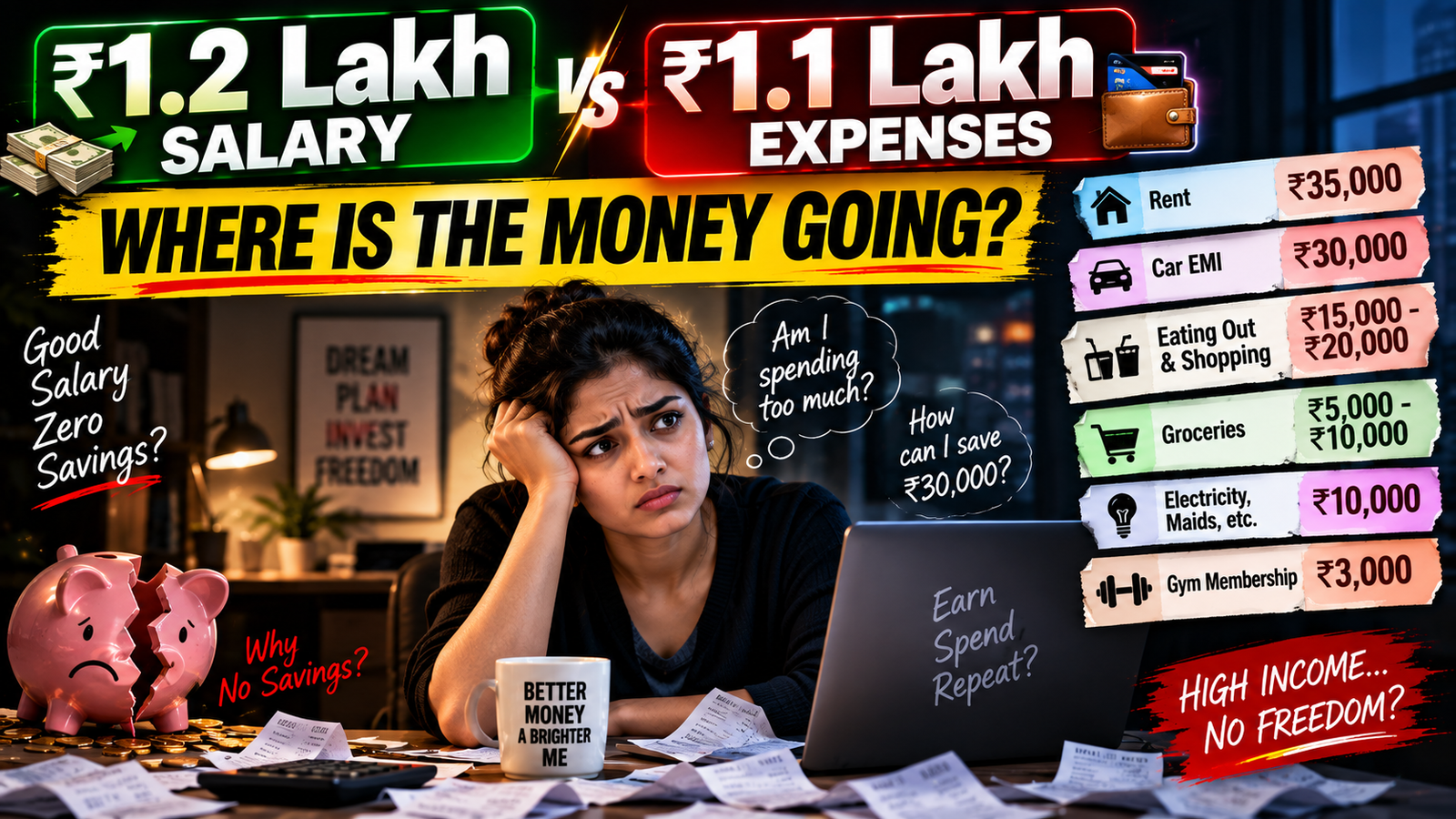
Hi friends, my name is srikrishna, Very recently, I came across a viral post on Reddit written by a young female worker. She is earning a take-home salary of around ₹1.2 lakh rupees per month after taxes. However, she is spending a significant portion of it: ₹35,000 on rent, ₹30,000 on car EMIs, ₹15,000 to ₹20,000 on eating out and shopping, ₹5,000 to ₹10,000 on groceries, ₹10,000 on electricity, maids, etc., and ₹3,000 on a gym membership. Her total monthly expenses come out to be around ₹1.10 lakh, meaning she saves almost nothing from her ₹1.20 lakh income. She posed two questions to the community: “Am I spending too much?” and “Where can I cut down to be able to save a minimum of ₹30,000 per month?”. Before I reveal my strategy, I want you to pause and leave a comment sharing whether you think she is overspending and which specific items she needs to cut down. Taking a few moments to think about this is highly beneficial for your own financial learning. Let’s look at how she can fix her finances to achieve financial freedom by a target age. First of all, kudos to her for earning such a strong income so early in her career; not a lot of people achieve that.
Analyzing the Rent: The Aging Framework

Her single largest expense is rent at ₹35,000 per month. To understand if this is too high, we calculate her rent-to-take-home salary ratio, which sits at roughly 30%. In the US, people have blindly followed a traditional “30% rule” for a long time, but it is outdated. Instead, rent budgeting should depend on your age, take-home salary, and financial goals. I use a dynamic framework based on these parameters. For someone early in their career earning less than ₹1 lakh, the maximum rent ratio should be 15%; for an income of ₹1 lakh to ₹3 lakh, it should be 20%; and for incomes above ₹3 lakh, it should cap at 25%. As you get older, you can afford slightly more: 20% max if you make under ₹1 lakh, 25% max for ₹1 lakh to ₹3 lakh, and 30% max for incomes over ₹3 lakh. Once you pass a certain age milestone, you shouldn’t be renting at all; you need to own your house. Prominent figures on social media, like Nikhil Kamath, previously claimed they would never buy a home, yet even they bought a house eventually. It is a critical milestone. Applying this logic to her case—she is in the younger age bracket and earns between ₹1 lakh and ₹3 lakh, meaning her rent ceiling should strictly be 20%, or ₹24,000 per month. When you earn a good income, you deserve to live well and enjoy your life, but you must establish boundaries. For ₹24,000, she can easily find a very nice, decent one- or two-bedroom flat in a good, non-posh society. By downsizing slightly, she would immediately save ₹11,000 per month.

Her second biggest expense is the car EMI of ₹30,000 per month. Assuming a loan amount of roughly ₹15 lakh at an 8.5% interest rate over a standard period, this matches her current payment structure. Many people might criticize her and tell her to take public transport or ride a scooter to the office. However, I disagree. Driving a two-wheeler on Indian roads is highly dangerous, and the massive amounts of pollution, dust, potholes, and traffic conditions make it incredibly tough. Additionally, public transport infrastructure for buses and trains is often in a tough state. Buying a car for a safe, dust-free, air-conditioned, and comfortable commute is actually a very smart choice. Her mistake was buying a car that required a massive ₹30,000 monthly EMI. Early in your career, if you let go of trying to show off, you could opt for a quality used or secondhand car, like a slightly older Tata Punch, costing around ₹5 lakh. Running the same loan calculations for a ₹5 lakh loan at 8.5% interest yields an EMI of only ₹10,000 per month. This single lifestyle adjustment saves her another ₹20,000 per month. Combining the ₹11,000 saved from rent and the ₹20,000 from the car EMI allows her to retain ₹31,000 per month without significantly lowering her standard of living.

The Car Expense: Striking a Realistic Balance

Discretionary Spending and Better Budgeting
Next, we look at her ₹20,000 monthly spend on eating out and shopping. This is an area where younger financial habits are often completely broken. I recently reviewed a friend’s Swiggy statement where they spent ₹1.21 lakh over a few months, averaging ₹35,000 a month on food delivery. While that might seem extreme, many young professionals spend excessively on food delivery platforms purely for convenience and taste preferences. Expressing yourself and enjoying life when you are young is completely fine—you shouldn’t wait until you are old to start living—but you must draw a hard line. A logical ceiling for discretionary lifestyle spending is 10% of your take-home pay, which equals ₹12,000 per month for her. By sticking to this, she pockets an extra ₹8,000 every month. Adding this to our running total brings her cumulative savings to ₹39,000 per month. Her other expenses, such as groceries, utilities, maids, and the gym, are perfectly valid and don’t need to be cut. With comprehensive budgeting, saving ₹40,000 a month is entirely achievable. Out of this savings pool, I highly recommend allocating around ₹2,000 per month to secure comprehensive life and medical insurance. If she were to face an unexpected hospitalization, a sudden ₹40,000 medical bill would completely wipe her out because she is currently living hand-to-mouth. Protection is vital.
The Path to Financial Freedom

After setting aside money for insurance, she is left with a clean ₹38,000 per month to invest. If she regularly invests this amount, she can achieve complete financial freedom over a 20-year horizon. Assuming a realistic 10% expected annual rate of return from a well-diversified portfolio spanning the Indian stock market, US stock market, gold, and fixed income instruments, her corpus will grow to ₹2.89 crores. If the portfolio performs slightly better at a 12% return, that amount grows to ₹3.76 crores. Furthermore, if she steps up her monthly investment by just 10% every year, a 12% annual return would build an incredible corpus of ₹7.5 crores over that same horizon. All it takes is the discipline to save. I made plenty of financial mistakes when I was young because nobody taught us these principles, and many young people today are stuck in a short-sighted mindset. Enjoy your youth, but balance it with smart planning and investing. Learning to invest is a highly underrated skill. Look at safe, simple options like the RBI Floating Rate Bonds, which offer stable 8% returns with virtually no risk. Consistently spending just a few hours a week learning about investments and building a diversified portfolio will easily guarantee your financial freedom. Please let me know your feedback and questions in the comments below!