
📊 Introduction & The Investment Debate
Hi friends, what is the best option to invest your money? I’m giving you four options: number one is bonds, number two is mutual fund SIPs, number three is gold, and number four is direct stocks. It’s extremely important to choose the right investment vehicle. Otherwise, instead of making wealth, we might end up losing our money. And the reason I’m making this video right now is because if you look at the last 2 years, Nifty 50 SIPs have given 51% of CAGR returns. Can you believe that? That is shocking. On the contrary, if you look at the domestic prices of gold, gold has given around 46% CAGR returns in the last two years from a SIP point of view, and this has triggered a big debate whether FDs are good, bonds are good, mutual funds are good, gold is good, or direct stocks are good. In this video, I’m going to present to you some data which will give you absolute clarity about when to invest in these four options and which is the best investment option according to specific variables. Please do not skip this video, very very important video. With that, if you’re new to my channel, my name is Rahul Jain, I’m a SEBI registered research analyst. If you want to support me, hit that subscribe button now.

➡️ Option 1: Government & Corporate Bonds

So let’s start with the first option, which is bonds. Broadly, there are two types of bonds: number one is government-issued bonds and number two is private companies like NBFCs, they also issue corporate bonds, okay?

Now let’s talk about the government bonds first, okay? For example, RBI Floating Rate Bond. This bond is giving 8.05% of interest rate as of now. Okay, now is this a better option than SIPs or not? Let me give you one minute commentary about it. Let’s say we invest 1 lakh rupee in this particular bond. After 1 year, how much we’ll get? Around 1 lakh 8,000 rupees. The risk is 0% here because it is a government bond, there’s a government guarantee that you will get this 8% or 8.05% of interest. Right, 1 lakh 8,000 you will get. Now there is a tax on it. How much is the tax? It is as per your income tax slab. So the 8,000 rupees that you got as interest, you will have to pay tax on it depending on your income tax slab. Now assume that if your income tax slab is 0%, that you are below 12 lakh rupees of income, therefore your income tax liability is zero, then this becomes absolutely tax-free for you. Meaning you get 1 lakh 8,000 rupees guaranteed no matter what happens, which government comes, which government remains, what happens to the economy, nothing, it doesn’t really matter. You get that money.
Now if you compare this with a SIP which might give you a 10% return, okay, versus SIPs at 12%, I’ve done both the calculations. If you do at 10%, your 1 lakh becomes 1 lakh 10,000 after 1 year. For simplicity, I’ve taken a one-year calculation so that we get the concept right, okay? Now after 1 year, you’ll have to pay 12.5% long-term capital gain on this 10,000 rupees. 1,250 rupees gone from that, it comes out to be around 1 lakh 8,750 rupees. So a very similar sort of return you get in SIPs at 10%, and that is market-linked, that is not guaranteed, okay? But you end up paying 12.5% tax irrespective of what is your tax liability, please understand this. So just imagine somebody who is not having any income tax liability or who is below the income tax limit, for them RBI Floating Rate Bond gives them that certainty, and it is a much better option than generating SIPs at 10%. How about SIPs at 12% then? In that case, yes, it makes sense, okay? But can you do SIPs for one year if you have to invest for one year? No, SIPs you can’t. For that matter, corporate bonds also you can’t just invest for one year, you have to leave that money for a minimum of seven years, there is a lock-in here, okay? So these are the pros and cons. But if you are a person who does not want to take any market-linked risk, okay, in terms of what is likely to happen to the economy, market crashes may happen, and you only want to invest with a certain outcome that you want to expect, and your income tax liability is 0%, then RBI Floating Rate Bond is a better option in that particular scenario, okay?
Now let me talk about the corporate bonds. So corporate bonds are the bonds that are issued by private companies, maybe NBFCs, for example, okay? Now the corporate bonds may give you a typical interest rate between 9 to 12% depending on the credit rating of the bond. Now for simplicity, if I assume a corporate bond that is giving you an 11% coupon rate or interest rate, okay, what the calculations will be? So again, the same number, one lakh. If you invest after 1 year, 11% means what? 1 lakh 11,000 rupees. Now these corporate bond interests are also taxed as per your income tax slab, okay? And if your income tax slab is below 12 lakh rupees, meaning you’re not paying any income tax, then imagine you are getting 11% tax-free. Of course, there is a credit risk with the corporate bonds, it is not guaranteed, it is not safe. There is a credit risk that your entire money might be lost, okay? That risk you are taking.
But that risk versus SIP risk… Now let me talk about SIPs at 10%, 12%, and 14%. And if you do the calculations here, SIPs at 10% will actually lose wealth here. SIPs at 12% also, after 12.5% tax, are going to be much lower than the corporate bond that is giving you 11%, please understand this difference, okay? And SIPs at 14%, yes, definitely will beat corporate bonds which are at 11%, even after tax, okay? Now here the decision is based on what? Your income tax slab, that is number one. But what happens if your income tax slab is, let’s say, 10% or 30%? If your income tax slab is at 10%, then SIPs at 12% and 14% are better options. But if your income tax slab is 30%, then SIPs are a better option if you’re thinking long term, okay? Now tax plays a very very important role, and also the risk plays a very very important role here because SIPs are market-linked. You can never expect SIPs to give you 12%, 10%, 14% in one single year. Shorter duration SIPs do not work. I showed you in fact, during the beginning of this video, that Nifty 50 in the last two years has given you only and only some 51% return when it comes to SIPs. So actually, people who would have invested in corporate bonds in the last two years would have made more money as compared to SIPs.
So what you need to think about corporate bonds is that if you want to invest for the short term, be it 1 year, 2 years, 3 years, that is your time horizon, and if your income tax bracket is like 10% or maybe 0% or maybe 15%, 20%, not more than that, then it may make sense that you go for corporate bonds as compared to mutual fund SIPs because mutual fund SIPs may not give you returns in the short term. In fact, you might lose your money. I’ve seen people going negative into SIPs. Now I’m not saying SIPs are bad, SIPs have a purpose which I’m going to explain to you with a few good examples so that you get this concept very very clear. So the first option is corporate bonds, we have talked about when are they important, when are they not important, and likewise the government-issued bond if you want a government guarantee. But the summary is very very simple: that if you want short-term cash flow coming your way, your income tax liability is very very low, and if you are happy with guaranteed returns and you don’t want to go to market-linked returns, then corporate bonds and government-issued bonds are a very very good option. They are not bad options at all. Of course, there is a credit risk with the corporate bonds, but so is the risk with SIPs or gold or, for that matter, stocks, which I’m going to talk about now in the next few minutes. But this is the analysis that you need to understand, keep it in your mind whenever you are investing your hard-earned money. If you like this, request you to hit the like button.
➡️ Option 2: Mutual Fund SIPs & Volatility Strategies

With that, let’s move to option number two, which is mutual fund SIPs. Second option is SIPs in mutual funds or even lumpsum investment in mutual funds, okay? A lot of people have started saying that SIPs in Indian stock markets are dead. Why? Mainly because Nifty 50, if you see the last two years, has given around 51% of annual returns, that is extremely poor, and that’s why people have started talking about SIPs do not give returns etc., but they’re only looking at the last two years. Even if you look at the last two years, let me present to you now a couple of data points. Here is the Midcap index, Midcap 150, same time period. This index has delivered around 12.1% CAGR returns in just the last 2 years. Forget about midcaps, let me talk about small caps that had crashed from September 2024. If you look at their SIP returns in the last 2 years, 12.87%. This is in spite of us having the market melting down like anything in the last couple of years, mainly because small caps were crashing after September 2024, and then the Iran war hit us badly, and then the stock market was going haywire. Even after that, SIPs have given in the last two years in midcap/small cap around 12% of CAGR returns.
But here is the main thing that you need to know if you ever want to do a SIP, okay? Do not do SIPs for 1 year, 2 years, or 3 years. Please don’t do this mistake, okay? Historically, data has shown us that if you are doing SIPs for 7 years plus, then you are likely to have better returns expectations from the market, okay? 85% chances are there that you might get around 10% of returns looking at the history, okay? 7 years is the minimum time period if you were to start any SIP. So before you start any SIP, just ask yourself a simple question: “Can I continue these SIPs for the next seven years?” If you think you can, 100% guaranteed do it, otherwise don’t do it, okay? This is the basic thumb rule that you need to keep.
Now let me talk about lumpsum investments in mutual funds. Is that a good way if people are not doing SIPs? I’ll present to you some options. So if you do lumpsum investment, the beauty is that every single year Nifty 50, for example, temporarily falls between 10 to 20% from its peak. Even now Nifty 50 is down—I mean, the peak was at around 26,200-300 long back, it’s still at 24,000 when I’m recording this video. 10 to 20% of average inter-year decline happens in Nifty 50. If you go to midcaps and small caps, this decline is even more frequent and sharper. For example, here you can see Midcap 100, 47% of the time it trades below 10% from its peak time. In small caps, around 63% of the time it is trading below 10% down from the peak, okay? So there is good volatility in midcaps and small caps. And if you’re a lumpsum investor, what you could do is rather than doing SIPs, you can put that money in, I don’t know, a liquid mutual fund every month, okay? And if the market is down whenever 10%, 15%, you take that money out from the liquid fund and deposit this into a midcap or small cap or wherever you want to invest. That is one strategy that people use in SIPs or in lumpsums.
What really matters is where are you actually investing, okay? In this video in my Hindi channel, I have talked about the top 10 index funds that have generated wealth for people in the last 10 years—high growth, high returns—provided you can remain invested. Go and learn about those indexes. If you learn about high growth indices, and if you sort of take your bets according to those growth areas and remain an investor for seven years, then you’re not likely to lose money, in fact, you’re likely to make money, that is what history is telling us. So in order to sum it up, SIPs are not bad. First thing is you only invest in SIPs if you have seven years or more as a time horizon. Second, you’re okay to sit through the volatility and not panic. A lot of people pulled out their money during the US-Iran war that had hit in March 2026 because markets were at the bottom, they panicked, they took their money out—never do that. And third is that if you do not really understand stock investing, direct stock picking, then mutual funds are your best way to generate wealth if you can remain invested for more than 7 years or so.
And last point on SIPs is that if you are falling under a high tax bracket, okay? If your income tax liability is like 20%, 30%, then FDs are not going to do justice for you, bonds are also not going to do justice for you because, for example, a 10%, 11% of bond yield that you are getting, and if you’re paying 30% tax on it, then you’re gone. How much are you earning? 6%, 7%? That is like almost equal to inflation, so you don’t really have any other option than to go for equity. I’ll talk about gold also in a minute. Hopefully, you’re getting this rounded view: that if you’re in a high income tax slab, and if your time horizon is longer, then the shorter instruments like FDs, corporate bonds, these are not good for you. And if you don’t understand stock picking, then what options are you left with? Either mutual funds and gold, right? So mutual funds, I’ve given you that commentary. Let me now move to gold—very very important 3 to four minutes of commentary you need to absorb about gold so that you can learn about gold as well. So far, if you’re liking this video, request you to hit that subscribe button so that you continue to learn with me.
➡️ Option 3: Gold Asset Dynamics & Constraints
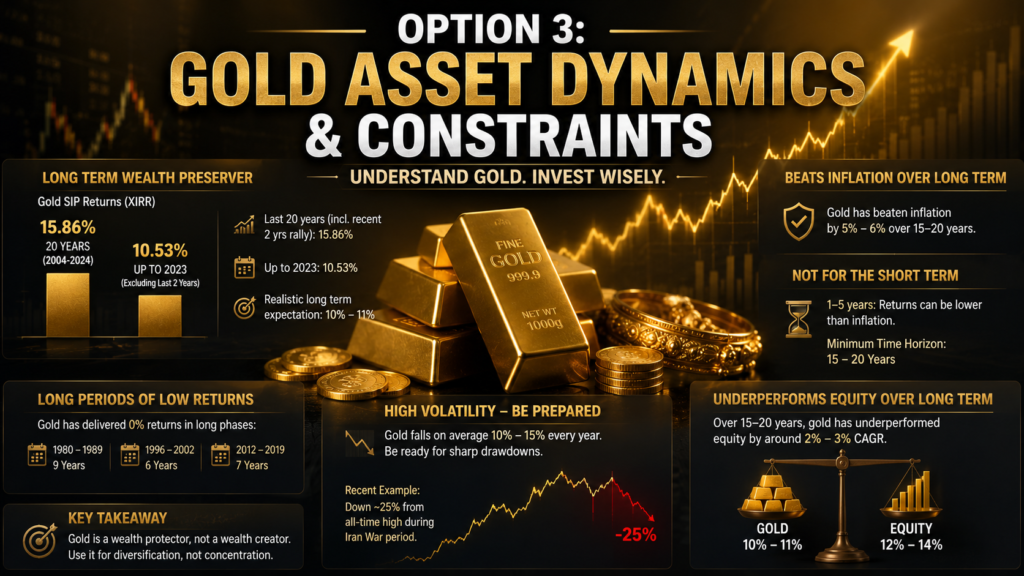
With that, let’s move to gold now. Now let me speak about the third option, which is gold, okay? Last 20 years of gold SIPs, if I consider domestic prices of gold, that has given around 15.86% of CAGR returns from a SIP perspective, so XIRR returns, okay? But this looks very very high to me, right? Because if you look at the last two years, okay, how much of SIP returns we have got from gold? Around 46%, right? This means that the last two years of high SIP returns have distorted the 20 years of returns, right? So if I remove the last two years to see what were the returns up until 2023, it comes around to be 10.53%. So what I’m trying to get to is that over a longer period of time, 15 to 20 years of time horizon, your expectation from gold should be around 10 to 11% of annual returns, not more than that, okay? Because the current 15% looks very very high to me because of the massive rally that we have seen in the last two years. It might go up, it might come down, I don’t know about that. But the point is that your expectations from gold should be around 10 to 11% for a longer period of time.
Now the good part about gold is that it has comfortably beaten inflation by 5 to 6%, okay? But the problem is that you have to have at least a 15 to 20 years of time horizon if you’re investing in gold, this is what the data is showing us. That if you look at the 15 to 20 years of time horizon, then definitely it has beaten inflation by 5 to 6%. But if you see, if you’re investing only 1 year, 2 years, 3 years, 4 years, 5 years, you might get lower returns than inflation. This is what you need to understand with gold: that it is not for the short term—1 year, 2 years, 3 years, 4 years. In fact, 10 years is also not suitable for gold, a minimum 15 to 20 years of time horizon is what you need to take with gold.
Now having said that, somebody might say that, “I will only invest in gold because you know I’m going to invest for the next 20 years, so I’ll put all my money in gold.” That is also incorrect because if you compare this with SIPs or equities, then it has underperformed equity by around 2 to 3%, even if you look at a 15 to 20 years of time horizon, right? So you might lose a lot of wealth just by putting all your money in gold because equities have done well over the 15 to 20 years of time horizon. Another very very important point with gold is that there might be a long period, like a 10 years period, 15 year period, where gold may not give you any returns. This has happened in the past: 1980 to 1989, 9 years 0% return; 1996 to 2002, 0% for almost 6 years; 2012 to 2019, 0% return. So are you okay to sit down with gold for 7 years, 8 years not taking any returns? And in fact, during that period you might see a drawdown in gold. For example, if we see right now, okay, since the Iran war started, gold is down from its all-time high by almost 25%. People who got it at an all-time high, they might be crying right now that gold is down by around 25%, right? So during the intra-year… So here is the data for you that if you look at every single year, gold falls by around on an average 10 to 15%. So it is a volatile asset, it is not an asset that you can just buy and forget about it. You have to sit through the volatility for at least 15 to 20 years to be able to make good 10% or 12% returns from gold, it’s not easy at all. I can tell you, whenever gold falls people do panic, and when gold is not giving returns people do worry about it—that their money is sitting in the locker not giving them returns. It’s only our grandparents that were wise enough to say that, “You know what, I’ve bought the gold, I’m going to put that somewhere in the locker and not touch it.” That mentality has to be there if you’re investing in gold.
But you cannot put all your money in gold because equities have outperformed over 15 to 20 years. So therefore, coming to the question, that in my view gold 20% max, 20% not more than that. And yes, from a long-term capital gain tax perspective, if you see—be it physical gold, ETF gold, mutual fund, digital gold—all of these components are taxed at 12.5% if you’re holding them for more than 2 years for mutual funds, digital gold, and physical gold; for gold ETFs it is 12 months, okay? So from a taxation perspective also, it is at par with SIPs, right? 12.5%, which is a good thing. But overall, a 15 to 20 years SIP will definitely win in my view, okay, as compared to gold. Having said this, gold is needed because of a currency hedge, right? You might be migrating from one place to another, physical gold you can carry with you. But SIPs in mutual funds, it’s all digital and it really depends on what happens to the mutual fund house, what happens to the economy, where is it going. Therefore gold retains global relevance. You can move from one country to another, carry your physical gold, you’ll still be fine, okay? It has happened when people moved from India to Pakistan, Pakistan to India: they could not carry their properties, they could carry their physical gold. So that’s the relevance of gold and it definitely demands around 20%, maximum 20% of allocation for your portfolio. It’s not a bad investment, but you have to understand the nature of this investment: that it has to be for 15 to 20 years, not for “I’m going to make some quick money here and there.”
➡️ Option 4: Direct Stock Selection & Probability Data
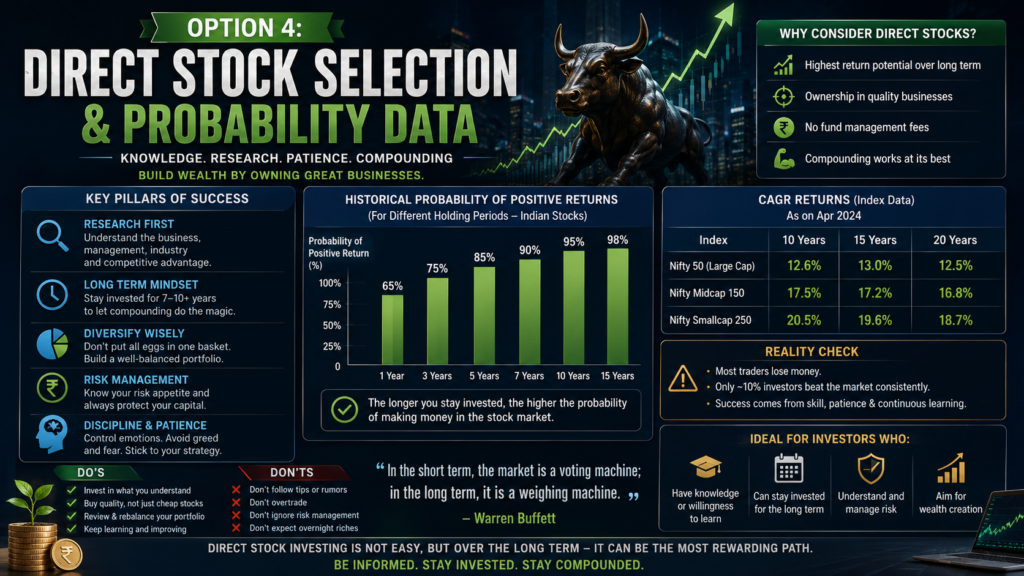
So this is about gold, the third instrument. With that, let me move to number four, which is stocks. A very very important analysis that I’m going to show you in the next 2 to 3 minutes. Now comes stocks. Should you invest in stocks or not? Will stocks make wealth for you or not—direct stocks, I’m talking about. So here is an interesting data point for you. I’ve taken the top 500 stocks as of now and I’ve seen their last five years CAGR returns, how much returns these stocks have given, and I want to show you some data points, okay?
So here, if I talk about how many stocks have given more than 50% CAGR returns out of these 500, you get 40 stocks, okay? Meaning 40 stocks out of 500 have generated 50% or more annual returns for 5 years, meaning almost every 1.4 in four years, right, the money has doubled, okay, for 5 years. Can you see that? This is the beauty of stocks. But only 40 stocks have managed to do this out of 500, okay? It’s not that every stock will do that to you, okay? Now coming to how many stocks out of these 500 have generated 17% or more CAGR returns, okay? I’m going to say 17% or more, and you see 193 companies out of 500 companies. 193 companies have generated 17% CAGR returns. That is good, that is not bad at all, provided you know how to select companies which are likely to be in those 193 companies, okay? Now let me do the third one, which is around how many stocks out of these have generated better returns than FD returns. So let me say 7% or more, and we get around 281, okay? So even if you go by probability, more than 50% of stocks have beaten FD returns out of 500. 281 have given more than 7% CAGR returns, okay?
This is analysis from a positive perspective. But what about losses in stocks? Stocks also have losses. So for that, what I’m going to do is I’m going to reset this and again say, “Give me only those companies that have generated negative returns in the last 5 years.” So I’m going to say up to 0%. So it comes around 58. So out of 500 companies, 58 companies have generated negative CAGR returns. So 90% of stocks have generated positive returns, and here around 10% have generated negative returns. And if I arrange them with the negative returns, okay, the maximum negative returns that we’ve got is around 16% on a CAGR basis, right? 15%, 16%. Again, I’m not disclosing the names of these stocks, that’s beyond the scope of this video. The idea is to teach you about the nature of stocks. So one thing that I can conclude from here is that if you can remain invested in stocks for 5 years, the chances of losses are becoming narrower. Again, it depends on the particular stock, but even if you go by probability, then the chances are reducing.
But people buy stocks only for tomorrow. “Can you suggest a stock that can go 30% up, 14% up in the next two years?” That is the question people get. People are not thinking beyond 3 years, I can tell you that. Nobody is thinking beyond 3 years when they’re picking stocks. Have you thought about more than 3 years whenever you’re picking stocks? People don’t, that mentality is not there. So a minimum of five years if you can invest, then you go for stocks, otherwise don’t even think of getting into stocks. But that is not the only criteria to enter into stocks. Definitely, stocks can build more wealth, a higher amount of wealth than the other three options because of the data that we have seen, because they can grow faster. But for that, what we need to know is: can we pick stocks? Do we have the skills to pick stocks, okay?
And here is what I tell people if they want to pick stocks, okay: for the first year of stock picking, do not put any actual money, do paper trading, paper investing, okay? For one year you’re going to say that, “I’m going to pick this stock because of XYZ reason, but I’m actually not putting my money, I’m putting this all in Excel and seeing what happens. Is my picking skill better or not?” That is for the first year. Between years 1 and 3, you get 3 years of experience. A maximum of 10% of your portfolio should be in direct stocks, not more than that, because you’re still learning. I’ve seen people putting 50%, 60% of their portfolio in just five to six stocks, and they do not even have 3 years of stock picking experience. They are going to lose money—guaranteed they are going to lose money, okay? No matter what the market conditions are, stock picking is dangerous when you do not have experience, right?
Let’s say you move from 3 to 5 years now. You’ve got experience of 3 to 5 years, slowly gradually you might want to now include more and more stocks in your portfolio. You might take your portfolio size, let’s say 20% in stocks. Why? Because you have that 3 to 5 years of experience, you’ve learned from your mistakes. But people don’t do that, people just want to make quick money. “I’m going to pick that stock because it is rallying,” and they pick up that stock at a very high price. It ends up correcting, they might lose money. So beyond 5 years, then you can say that, “I’m an advanced stock picker now, I have been investing for 5 years, I’ve been picking stocks with my own methodology for the last 5 years, and therefore, you know what, I am comfortable now. I know what to trade, I know what not to trade, how to analyze the company, and therefore I am confident now.”
This is how you learn about stock picking. And the way you make money from picking direct stocks is by having this experience. The first 5 years is a learning period, okay? Consider this as a business you are establishing your business, and you’re just learning every single day. You’re learning, you’re learning from mistakes. You pick a stock, it goes down by 10%, you know that you possibly made a mistake at this particular picking criteria, that’s how you fine-tune it, okay? Even though you make such a good framework for investment picking, you will still make mistakes, you will still see volatility in stocks because there are variables which are beyond your control, there are variables that you’ve not thought about, okay? And therefore that experience is needed because when the stock falls, can you still hold it? Do you still have that conviction in that particular stock or not? Those questions will haunt you, okay? So again, stocks definitely can build wealth provided you have the experience. And if you don’t have the experience, if you don’t have the time, then don’t venture into it, it is a dangerous game, okay? I’ve seen people losing a lot of money.
➡️ Ranking Assets & Diversification Framework
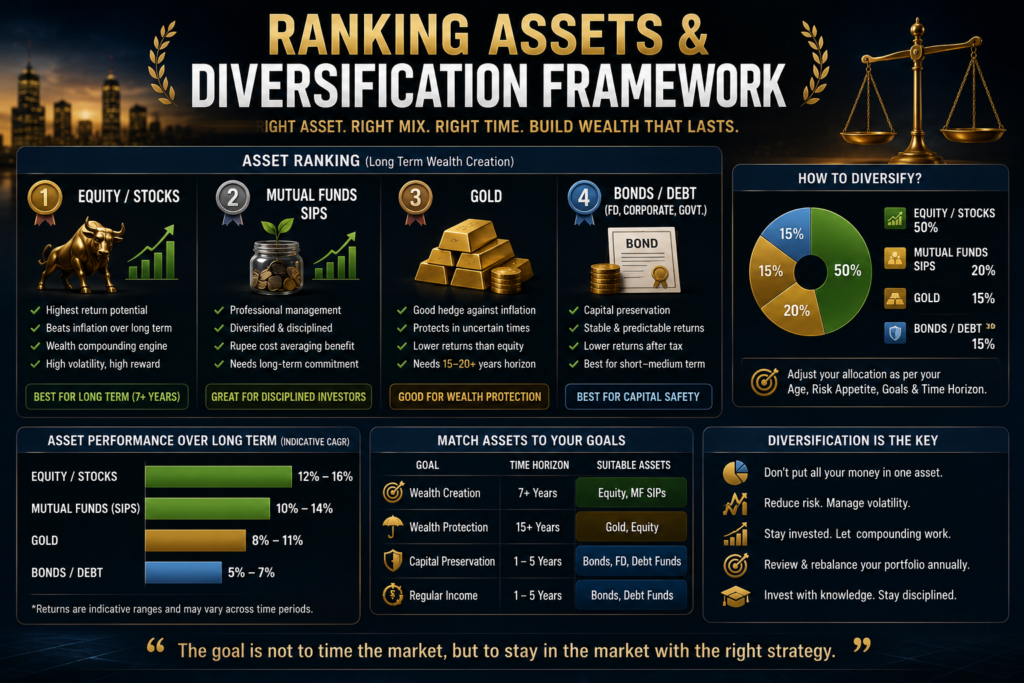
So if you look at these four options, what I want you to do is now rank them 1, 2, 3, 4 based on your personal circumstances: What is your stock picking experience? What is your income tax condition? Are you below 12 lakh? Are you more than 10%, 20%, 30%, okay? Are you investing for the long term or short term? If you’re investing for the short term up to three years, don’t go into SIPs, okay? Corporate bonds, FDs, those are the only options for you, okay? If you’re going for more than 15 years, then gold consider, otherwise don’t. These are the natures of these assets, and accordingly, you have to rank it. None of these are the best investment, none of these are the worst investment, it really depends on the variables that I’ve tried to lay down. There may be a few more variables—let me know in the comments what do you think those variables are before you go down to any of these investment paths. And of course, make a diversified portfolio. It doesn’t need to be all money going in SIPs, all money going in gold, all money going in corporate bonds, all money going in, for example, direct stocks. It really depends on these variables that I’ve tried to break down for you.