
Hi friends if I were to pick four to five stocks for a 2030 portfolio which can be considered mid to long-term time horizon, then I’m going to focus on high-growth sectors this is because, in a high-growth sector, even mediocre companies are likely to do well, Now I’m not saying that you do not consider other options—for example, banking stocks, FMCG stocks, or auto stocks. These are all evergreen stocks with some cyclicity built into them.
But please understand that these companies are unlikely to grow at a rate of, let’s say, 25 to 30% CAGR (Compound Annual Growth Rate) for the next 5 years. Therefore, it makes a lot of sense, in my view, to focus on high-growth sectors. So in this article, I’m going to text about four stock themes that are growing at a very, very rapid rate and are likely to continue to grow, maybe at a rate of, let’s say, 25 to 30% for the next 5 years, Throughout the article, I’m going to take a lot of stock examples These are only examples. Please do not take these as recommendations My intent is to make this session very, very practical for you because every stock tells us a story, and we need to grab that opportunity and the story. With that, shall we get this article cracking? Let’s go!

Sector 1: Capital Markets & Wealth Management
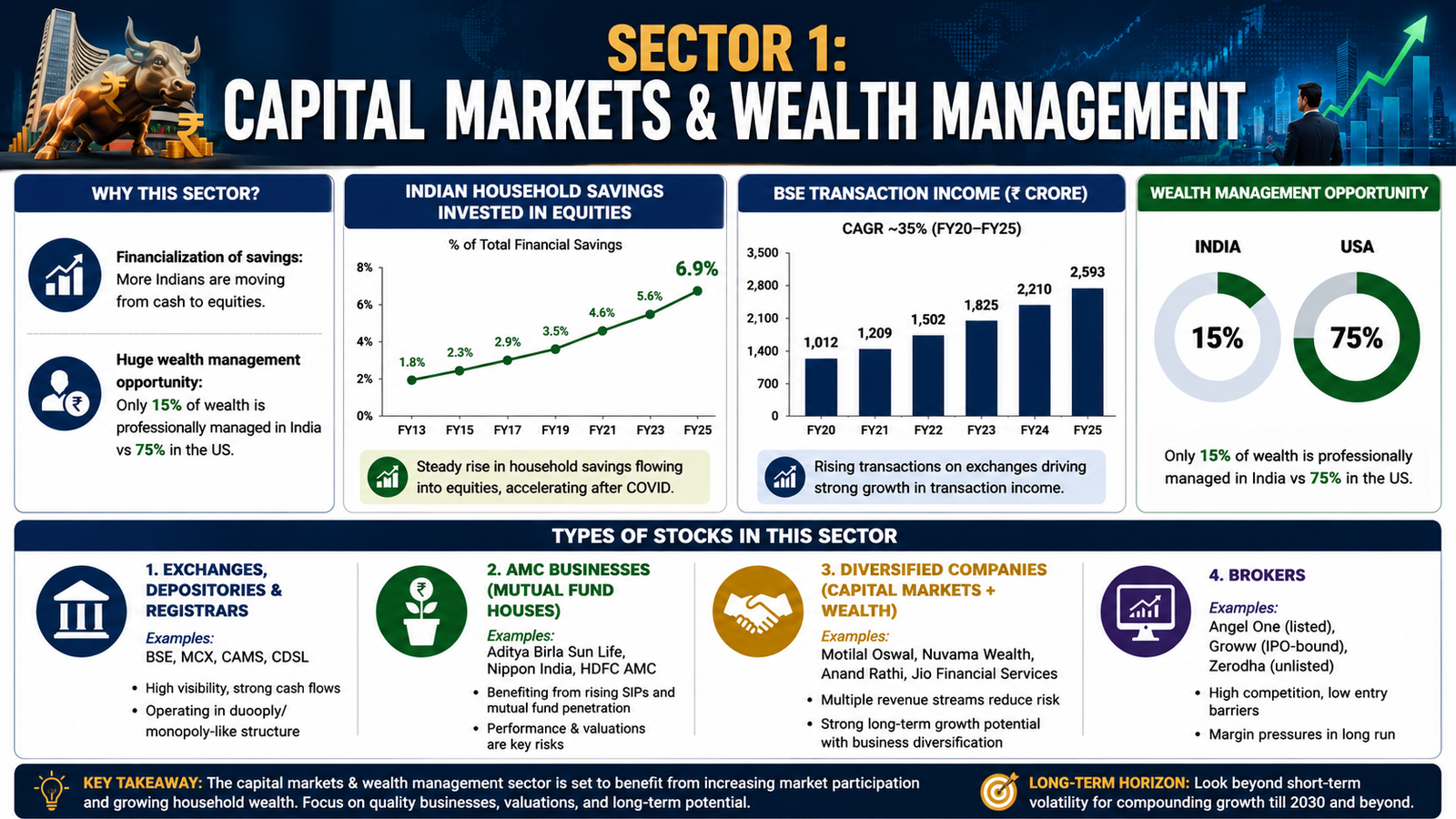

So the first sector is Capital Markets and Wealth Management. I’m going to present to you two critical data points so that you understand the opportunities in this particular sector, and then I’ll deep dive into a few sector-specific stocks, where the opportunities are, and what the risks involved in those types of stocks are. Have a look at my screen. The first data point you see here was published by Motilal Oswal recently. What you note here is that Indian households invest almost 6.9% of their savings into equities. That is a very, very small portion of household savings getting into equities.
And if you look at the last 10 years of trends here, what you will note is between FY13 and FY19, there was a steady growth rate in terms of how Indian households were putting money into equities. Versus if you see after COVID, from FY19 onwards, we have seen a steeper growth, and now we are standing at around 6.9% of Indian household savings getting into equity. What is happening right now is the financialization of savings for Indian households, because gone were the days when Indians would just store cash and not invest. Those days are gone now, and more and more people are now opting for equities.
And when more and more people opt for equities, what happens is that transactions on the exchange go up For example, if I show you some data points here, look at BSE’s transaction income, In the last 5 years, the income that BSE is getting from transaction charges has gone up by almost 35% on a CAGR basis from FY20 to FY25. This is likely to continue to grow as more and more people opt for equity as an investment tool, The second important data point that we need to focus on is what Nuvama published very recently: in India, only 15% of wealth is professionally managed, compared to 75% in the US. So there is a huge opportunity when it comes to wealth management. I talked about transaction charges and how India is investing in equity, which comes under the capital market segment, and this speaks about wealth management, So if you put Capital Markets and Wealth Management together, this sector is likely to see huge growth in the next 5 to 8 years and in fact beyond that.
Deep Dive into Capital Market Stocks
Let me now speak about a few sector-specific stocks so that you get a very good idea of what types of stocks are operating in this particular segment, where we should focus, and how we should de-risk our investments. For example, have a look at my screen and what you will note is that broadly there are four types of stocks, number one: Exchanges, depositories, and registrars. Examples include BSE, MCX (NSE is not yet listed), CAMS, and CDSL. These are very, very good companies. Number two: AMC businesses, which are your mutual fund houses. For example, Aditya Birla, Nippon, and HDFC are out there, There are very, very good AMCs. Number three: Diversified companies that are into both capital markets and wealth management, like Motilal Oswal, Nuvama Wealth, Anand Rathi, Jio Financial Services, so on and so forth. Number four: Brokers. For example, Angel One is a listed player, Groww is coming up with their IPO, and Zerodha is not yet listed (and I don’t know whether they will ever get listed).
Coming back to the first type of stocks, which are exchanges and depositories, let’s look at BSE. Very recently, I talked about BSE’s business model on my YouTube community and broke down its various aspects Their revenues coming from transaction charges are around 62% in FY25, This makes BSE a very strong stock because it operates almost as a monopoly (or a duopoly once NSE gets listed) More importantly, with 62% of revenues coming from transactions, the transaction volume on BSE and NSE is likely to grow further in the next 5 to 8 years as more people invest, Now, does this mean we go and buy BSE stock blindly? Absolutely not. You really need to understand when to buy stocks like these, because otherwise, you will end up buying them at a very high valuation and might lose money when the stock all of a sudden corrects.
Speaking of corrections, when stocks like BSE correct, those are good opportunities, in my view, to take bets. When will these stocks typically correct? Usually when there is fear in the market that transaction volumes are likely to come down, There are two primary reasons why transaction revenues may drop: When the stock market is bearish, the number of transactions starts to come down, We saw slightly fewer transactions around January, February, and March Regulatory intervention For example, just a couple of days back, SEBI decided that NSE is going to get Tuesday as its expiry date and BSE is going to get Thursday as its expiry date, Typically, a lot of transactions are done in the early part of the week, so NSE volumes are likely to go up compared to BSE, This creates short-term fear, causing the stock to correct In my view, when short-term corrections happen, it may be a good time to enter. Secondly, you need to look at valuations as well, not just price corrections A rough way of looking at valuation is checking the 1-year or 3-year median PE ratio For example, BSE’s 3-year median PE ratio has been around 69.3, and right now it is trading above that median PE You might decide you only want to enter when the PE ratio comes down toward the median.
Do not buy any stocks in a haste when they
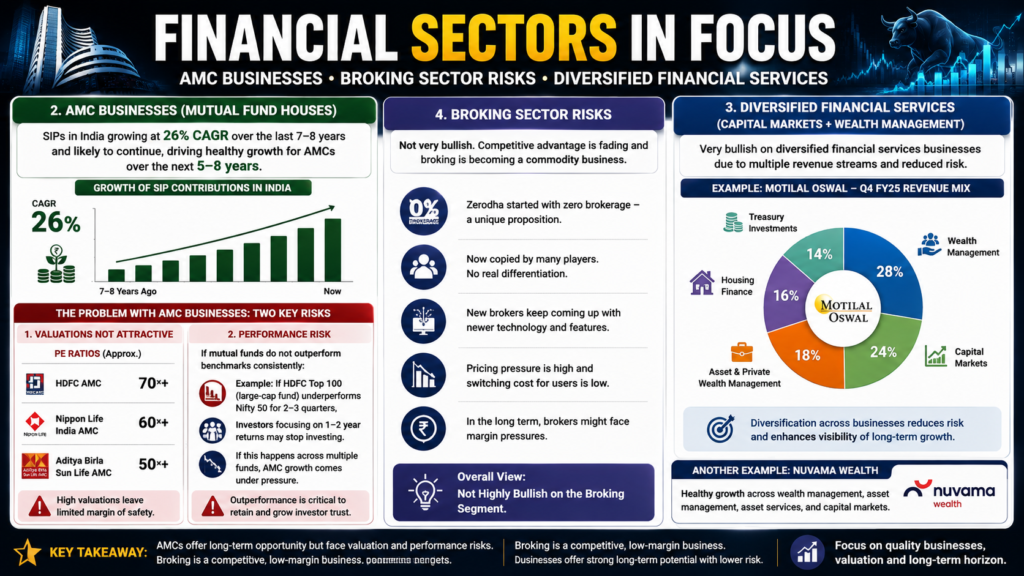
are just going up, up, up without any clue about where the valuations stand AMC Businesses & Broking Sector Risks Let’s move to the second type of stocks: AMC businesses like Nippon, HDFC, Aditya Birla Sun Life, etc If you look at SIP contributions over the last 7 or 8 years, SIPs in the Indian context have been growing at a 26% CAGR, The past shows good growth, and in my view, SIPs are likely to continue growing in the Indian market, bringing healthy growth for AMCs over the next 5 to 8 years But the problem with AMC businesses is twofold: Right now, valuations are not very attractive, in my view Look at the PE ratios of HDFC AMC, Nippon Life India AMC, Whenever AMCs or their mutual funds do not outperform their benchmarks, they lose their main selling point For example, if HDFC Top 100 (a large-cap fund) does not outperform the Nifty 50 for two or three quarters, Indian investors—who often look closely at recent 1- to 2-year returns—might stop investing in that fund If this happens across multiple funds, the AMC’s growth comes under pressure
That is the risk you need to be aware of
Now, skipping to the fourth category: Brokers I am not very bullish about broker stocks right now because the competitive advantage in this segment is fading It is becoming a commodity play When Zerodha started, they introduced zero brokerage, but that unique proposition has been copied by many others New brokers are constantly coming up with newer technologies, meaning there isn’t a massive differentiator In the long term, brokers might face margin pressures, so I am not highly bullish on the broking segment per Diversified Financial Services. Coming back to the third segment—the diversified segment (both capital markets and wealth management)—I am very, very bullish here If you look at Motilal Oswal’s business revenues from their Q4 FY25 presentation, they have highly diversified revenue segments: wealth management, capital markets, asset and private wealth management, housing finance, and treasury investments
becomes limited in well-diversified businesses when you are looking at a 5-year horizon
Another example is Nuvama Wealth Their latest results show healthy growth across wealth management, asset management, asset services, and capital markets Therefore, picking stocks from diversified businesses for a 5-year horizon makes a lot of sense I broke down this entire model for my paid YouTube community to show where growth is coming from. The risk of losing money Again, please do not take Nuvama or Motilal Oswal as recommendations, but these are the types of stocks I am particularly bullish about in this sector if you are liking this video so far, I request you to hit the like button, subscribe, and drop a simple “thank you” in the comments to keep me motivated to bring you zero-cost content You can also consider joining my paid YouTube community where I break down assets in very simple language With that, let’s move.
Sector 2: Semiconductor Sector

The second sector that is likely to grow at a very healthy rate by 2030 is the semiconductor sector Many of you know that India’s Semiconductor Mission started in 2021 with a ₹76,000 crore capital outlay by the government But what you may not know is that businesses setting up semiconductor facilities for 28 nanometers or lower get 50% of their project costs funded by the government Therefore, it makes sense to focus on semiconductor companies positioned to take advantage of this project funding Take Kaynes Technology as an example They are going to spend around ₹3,400 crores of capex for building a semiconductor fab, and they are likely to get 50% (₹1,700 crores) back from the government So, look for semiconductor businesses approved by the government that will benefit from this capex support. This PLI scheme of ₹76,000 crores (around $10 billion USD) is the largest commitment by the government across sectors, showing how serious they are in total, six companies have been approved by the Indian government The Tata Group has two plants under Tata Electronics—one in Dholera (Gujarat) with Powerchip, and a second one in Assam Tata Electronics is not a listed company yet It rolls up into Tata Investment Corporation Limited.
But the issue with investing in Tata Investment Corporation is that it is not a pure semiconductor play; they have investments in around 85 different companies if you are looking for a pure semiconductor business, Tata Investment Corporation is not it
Next, Micron Technology is a US company not listed on Indian exchanges, The Foxconn-HCL joint venture was recently approved for a ₹3,700 crore fab in Jewar, Uttar Pradesh, but to invest there, your only choice is HCL, which is primarily an IT company, not a pure semiconductor play. That leaves us with two listed Indian companies: CG Power and Keynes Technology Full disclosure: I am an investor in CG Power, having invested a year ago based on this semiconductor theme Let me bring you some insights into what these two companies are doing CG Power Analysis CG Power currently operates in two segments: Industrial Systems and Power Systems Industrial Systems generates more revenue (around ₹5,400 crores) compared to Power Systems (₹2,598 crores) In FY25, the company has done pretty well: sales grew by 23% year-on-year, and order intake went up by 35% year-on-year This is vital because these existing businesses need to generate cash that the company can use to fund capital expenditure in the semiconductor business.
However, looking at their P&L statement, this company has been slightly lumpy in terms of generating PAT (Profit After Tax) For example, in FY24 they generated ₹1,400 crores of PAT, but in FY25 it came down to ₹973 crores This lumpiness makes the company slightly riskier because sudden corrections can happen
Furthermore, news reports state they are going to roll out their first chip by mid-2026 It is not going to give them an immediate revenue or profitability boost in 2026; it may take another year or two for them to operate at 80% to 90% capacity Do not expect immediate financial rewards, which is why you must look at semiconductor businesses through a 2030 lens Another risk: CG Power’s partner in the semiconductor space is a Japanese company called Renesas Very recently.
A major US client of Renesas, Wolfspeed, filed for bankruptcy This created fear in the investor community about whether the joint venture between CG Power and Renesas would be affected Such fears can lead to sharp short-term corrections, but remember these are long-term strategies with inherent risks that you must continuously assess. Kaynes Technology Analysis Let’s move to Kaynes Technology, which is currently in electronics component manufacturing for automotive, industrial, railways, medical, etc, They’ve shown highly impressive growth over the last four years, with revenues growing at a 57% CAGR and PAT going up at around a 92% CAGR. Their order book as of Q4 FY25 stands at around ₹6,500 crores, which is a solid leap from around ₹4,100 crores in FY24, and represents over two times their annual revenue of ₹2,700 crores. Kaynes is a very high PE stock, which is a natural concern for investors Their 3-year median PE ratio has been around 116 It trades at a premium mainly because its profit and EPS are growing at a very rapid rate As mentioned, they are spending ₹3,400 crores on a semiconductor business, with 50% claimed back under the PLI scheme . According to management commentary, construction is in full swing, and they are likely to roll out their first chips in Q2 or early Q3 of this year. They expect a significant amount of capacity to be committed by customers before the end of the year. Meaningful financial contributions should start reflecting by the end of FY27 They also launched a ₹1,600 crore QIP (Qualified Institutional Placement) just two days ago, setting a floor price of ₹5,625 . This borrowing might temporarily pull down their ROE, and the floor price acts as a psychological benchmark for the market. Again, these are crucial updates for a sector that requires vision and patience for a 2030 horizon, rather than a short-term trade
Sector 3: Defense Sector

The third sector I want to speak about is the defense sector Global events like Operation Sindhudhvaj, the Israel-Iran conflict, and the Ukraine-Russia war show that the world is becoming unsafe day by day India is surrounded by neighbors like China, Pakistan, and Bangladesh, leaving us with no choice but to increase our defense spending. Our defense budget back in 2020 used to be around ₹3.37 lakh crores, and in FY26 it has gone up to ₹6.81 lakh crores—nearly doubling within 5 years By 2047, estimates suggest this budget could grow five times over to hit ₹31 lakh crores This makes the defense sector highly attractive from an investment perspective Crucially, there is a massive shift toward “Make in India,” meaning the government is buying defense products from domestic firms In FY23-24, domestic defense production hit around ₹1.27 lakh crores (a 174% rise since 2014-15) India has even started exporting defense hardware, crossing ₹21,000 crores in exports, with a target of ₹50,000 crores by FY29.
The majority of our defense purchases will be channeled to domestic firms rather than buying everything from France, the US, or Russia I won’t go deep into specific defense companies here because I recently created a dedicated video on the top three defense stocks in that video, I covered HAL and BEL (two PSUs) alongside a private sector player, Solar Industries India Limited Please watch that video to understand their business models My intent is purely educational so that retail investors can make informed decisions Let me know in the comments if you want a part two covering companies like Zen Technologies or Paras Defense.