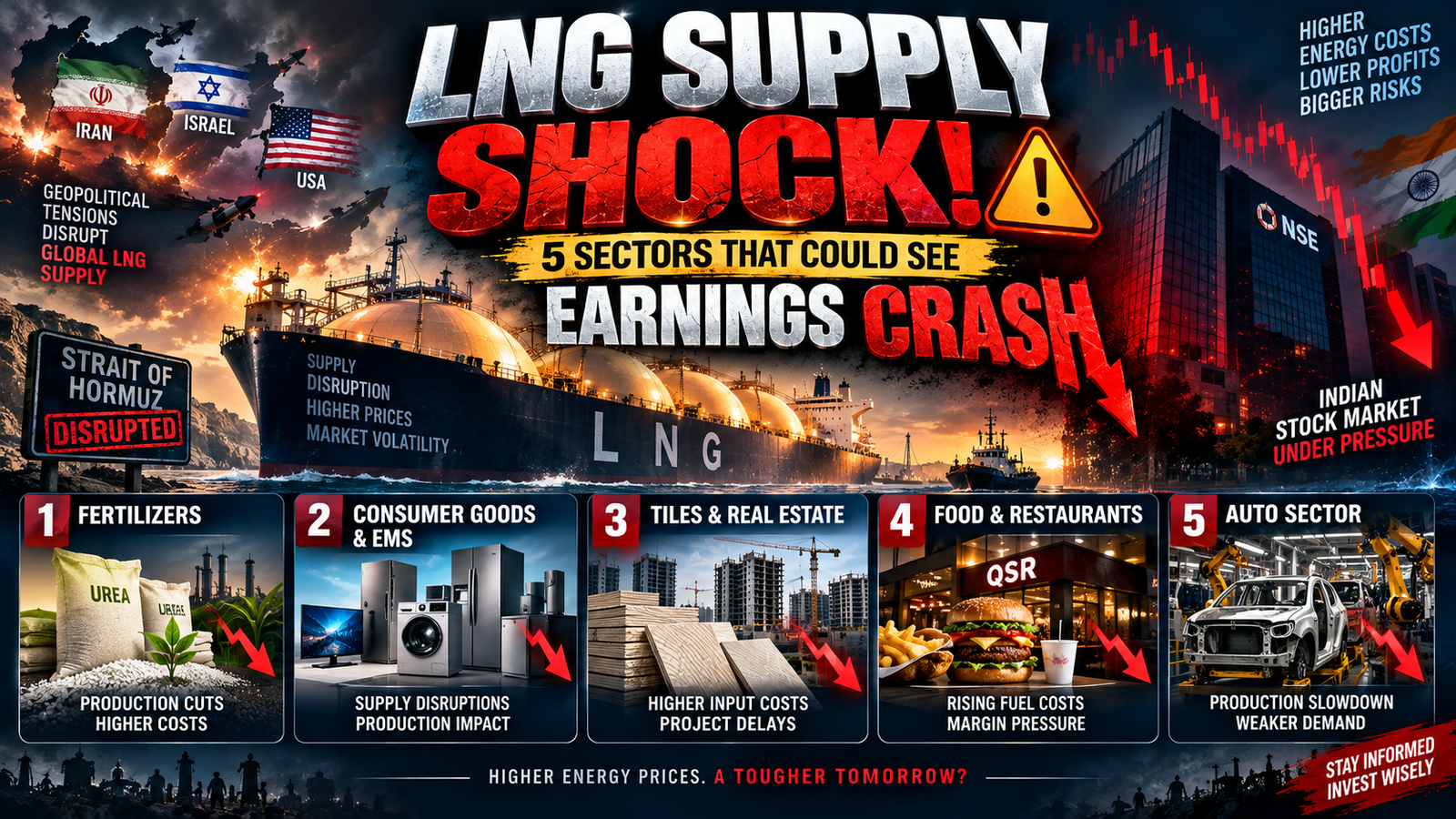
Introduction The ongoing geopolitical conflict involving the US, Israel, and Iran is no longer just impacting market sentiment; it has now started taking a toll on the actual fundamentals of Indian companies. While sentimental fear is driving initial market drops, the core issue stems from an emerging Liquefied Natural Gas (LNG) supply crisis. This crisis could potentially drag corporate earnings down, depending on how long the disruptions continue. Even if the geopolitical conflict resolves quickly, the downstream supply issues will take a brief period to iron out.

Why the LNG Crisis is Bigger Than the Oil Crisis While India’s crude oil supply routes through the Strait of Hormuz face disruption, the country retains alternative avenues, such as sourcing oil from Russia. However, natural gas is highly compressed into liquid form to make bulk transit possible where pipelines do not exist. With the closure of Qatar’s Ras Laffan facility combined with the Strait of Hormuz blockages, nearly a fifth of the world’s total LNG supply has been disrupted. India relies heavily on this specific channel, with a large portion of its imported LNG passing through the Strait of Hormuz. Consequently, Nomura estimates that nearly half of India’s total LNG import volume is actively at risk. Because most imported LNG feeds industrial production, this shortage directly hinders domestic manufacturing and risks driving up global natural gas prices similarly to the price spikes seen during the Russia-Ukraine war.

Government Response and Allocations According to a recent formal brief from India’s Minister of Petroleum and Natural Gas, Hardeep Singh Puri, India produces a significant portion of its natural gas domestically and imports the rest from Gulf sources. The government is actively routing alternative LNG cargoes to minimize standard shortfalls. To safeguard citizens, the ministry has mandated that domestic piped gas for households and CNG for public vehicles will receive full typical allocations. However, industrial and manufacturing sectors will face a mandatory supply cut, capped at a portion of their previous average consumption, while fertilizer plants will see their supply restricted even further.
Sector 1: Fertilizers
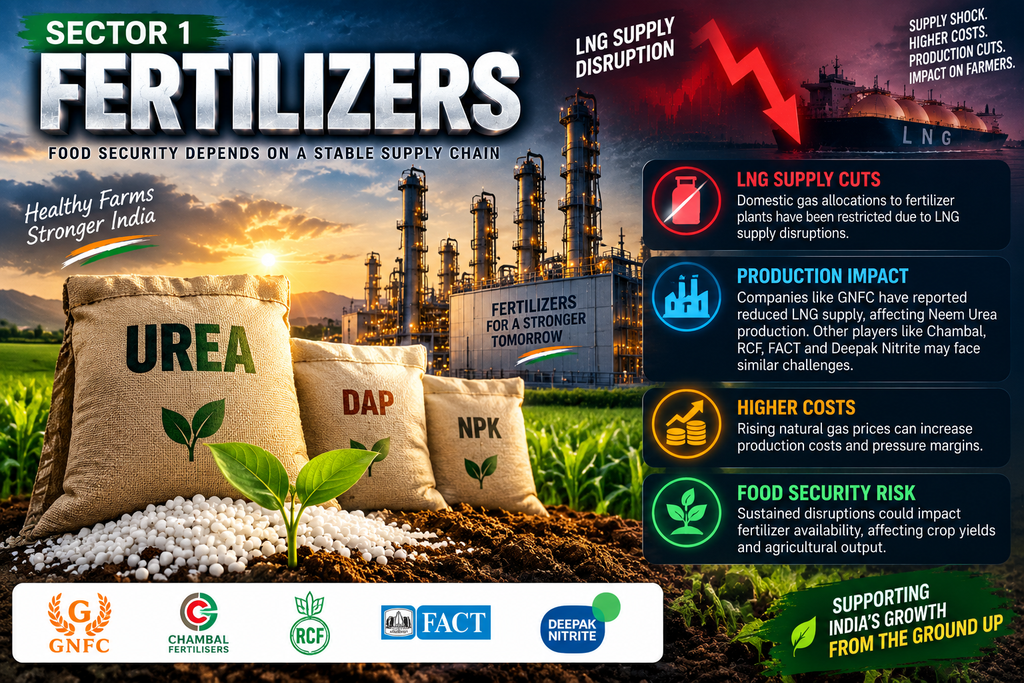
Fertilizer manufacturers are experiencing sharp baseline challenges. For example, Gujarat Narmada Valley Fertilizers & Chemicals Limited (GNFC) reported to the stock exchanges that its daily contracted LNG supply has been forcefully cut down, creating a direct supply deficit. Management noted that this disruption will negatively impact their primary production lines for Neem Urea. Other prominent urea manufacturers—such as Chambal Fertilisers, RCF, FACT, and Deepak Nitrite—are looking at similar operational reductions. While these drops will show up in corporate profit-and-loss statements later, the stock market is aggressively pricing in the damage ahead of time.
Sector 2: Consumer Goods and Electronics Manufacturing Services (EMS)
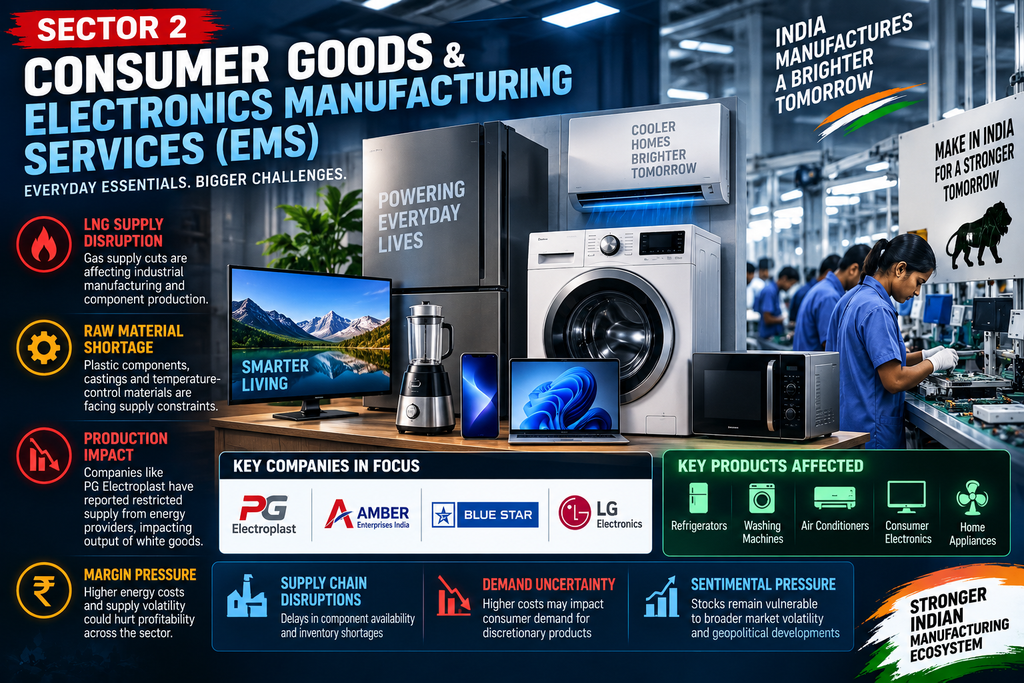
Sector 2: Consumer Goods and Electronics Manufacturing Services (EMS) Industrial manufacturers relying on components like plastics, castings, and temperature control are facing immediate inventory issues. Companies like PG Electroplast Limited formally disclosed to the exchanges that supply constraints from their energy providers have heavily restricted incoming quantities. This raw resource volatility affects production targets for household white goods, including refrigerators and washing machines. Major market players like Amber Enterprises, Blue Star, and LG Electronics remain highly vulnerable to both localized logistical cuts and wider sentimental trading panics.
Sector 3: Tile Makers and Real Estate

Sector 3: Tile Makers and Real Estate The ceramic tile industry is intensely energy-dependent, utilizing gas for high-heat manufacturing kilns. A massive portion of the industry’s default fuel base is currently restricted. Given that baseline energy overheads consume a huge chunk of total net sales, even a marginal increase in baseline fuel pricing will heavily drag down aggregate Earnings Per Share (EPS). Because major manufacturers like Kajaria Ceramics are taking a clear operational hit, this dynamic creates a domino effect that dampens structural cost projections for the broader real estate development sector.
Sector 4: Food and Restaurant Businesses
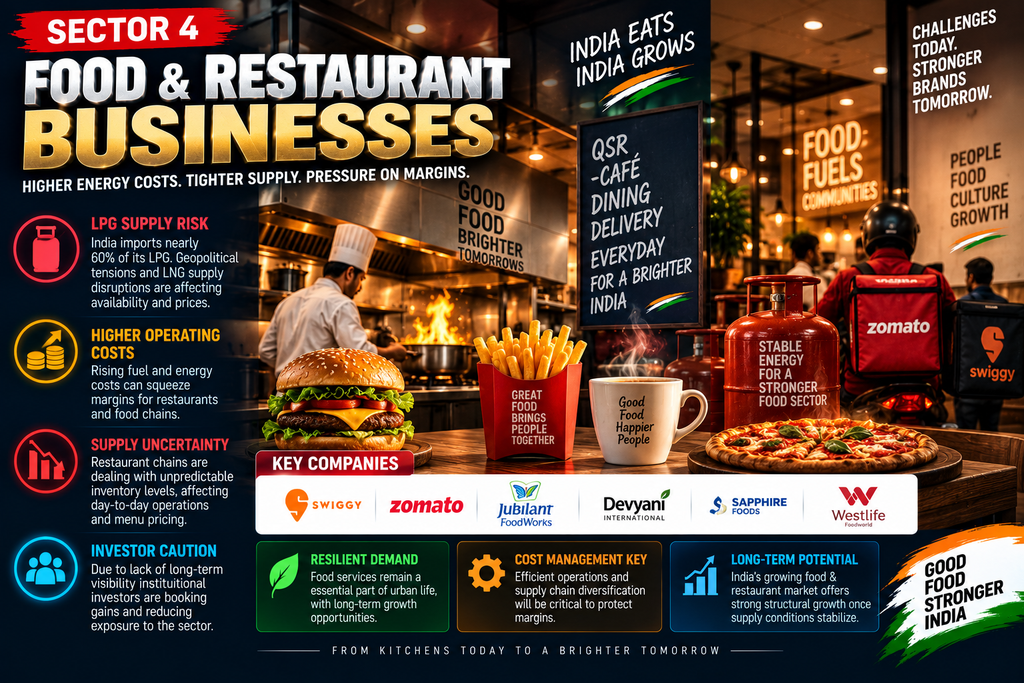
Sector 4: Food and Restaurant Businesses Quick-service restaurants and food networks rely directly on steady liquid petroleum gas (LPG) reserves, of which India imports nearly three-fifths. Massive commercial chains and delivery aggregates—including Swiggy, Jubilant FoodWorks, Devyani International, Sapphire Foods, and Westlife Foodworld—are handling quiet baseline shortfalls. Although the government is ordering local refineries to step up output, restaurant groups are dealing with unquantifiable inventory metrics. Faced with this lack of long-term visibility, institutional investors are locking in gains and selling off equities rather than trying to accurately predict future quarterly margins.
Sector 5: Auto Sector

The Nifty Auto index plummeted significantly, reversing recent regulatory momentum generated by positive updates and robust sales numbers. Flagship Original Equipment Manufacturers (OEMs) like Maruti Suzuki and Mahindra & Mahindra are dealing with a double-edged sword. First, limited gas supplies directly slow down production paint shops and metal casting facilities. Second, elevated energy and oil costs cause systemic inflation across the wider economy, which could cause a much deeper drop in consumer demand across both rural and urban areas.
Indirect Impact: Financials, IT, and Nifty 50 Allocation The financial and banking sector has dropped notably. This isn’t due to direct gas shortages, but rather aggressive Foreign Institutional Investor (FII) selling. FIIs are liquidating large blocks of passive index funds and broad market ETFs. Because major financial service companies command a massive portion of the benchmark Nifty 50 index, automatic asset manager sales force heavy liquidations down to individual constituent banking stocks. Coupled with a notable weight in an IT sector that is down from its peak, plus critical chunks in Auto, the index cannot recover quickly without structural relief like a formal ceasefire or geopolitical negotiations.
Long-Term Investor Perspective Market history proves that broad disruptions, even those far larger than the current energy bottleneck, ultimately clear up over time. Short-term stock prices almost always overreact compared to a company’s true long-term corporate health. For investors operating on a sound multi-year timeline, these sudden micro-cap and small-cap drawdowns are a standard feature of market volatility. As supply lines adapt and global pressures ease, production figures will stabilize, presenting a solid foundation for patient market wealth accumulation.