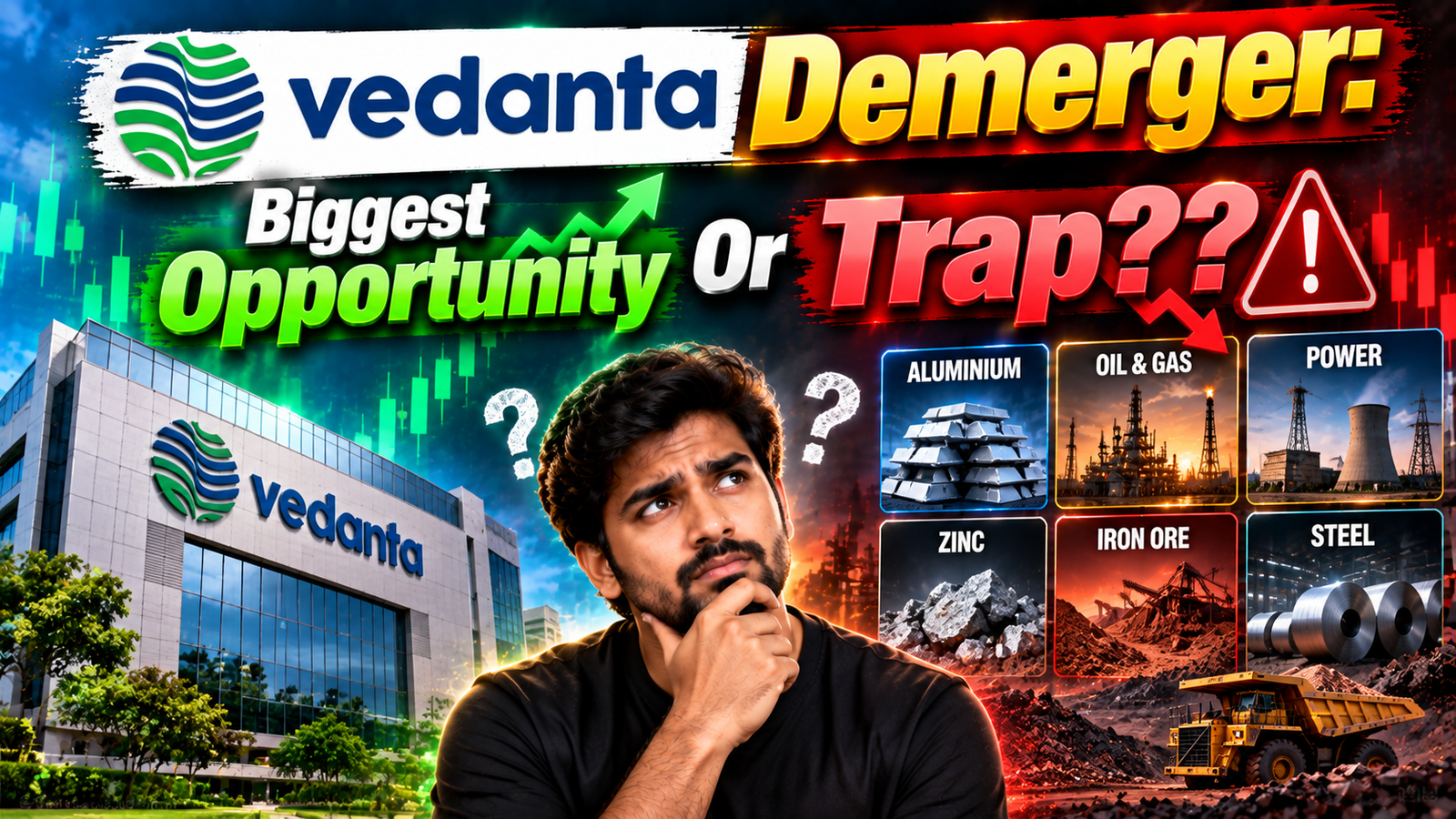
Overview: The Vedanta Group Demerger
The restructuring of the Vedanta Group represents one of the most significant and complex corporate demergers in the Indian market. As an investor, evaluating whether this demerger represents substantial value creation or an underlying trap requires analyzing the mechanics across several dimensions: initial price discovery, the allocation of specific businesses into distinct entities, capital expenditure pipelines, and the broader risks facing the group.
Price Discovery and Post-Listing Volatility
Prior to the restructuring, Vedanta Limited traded as a consolidated conglomerate. Ahead of the effective demerger date, Vedanta Limited recorded a closing price of ₹773.60 on April 29. Following ex-demerger price adjustments on April 30, the stock opened at ₹289.50 as the carve-out entities were separated.
On June 15, the four newly formed demerged entities were officially listed on the exchanges:

- Vedanta Aluminium Metal Limited: Listed at ₹522
- Vedanta Oil and Gas Limited: Listed at ₹38
- Vedanta Power Limited: Listed at ₹41.80
- Vedanta Iron and Steel Limited: Listed at ₹20
Under the scheme of arrangement, existing shareholders received one equity share of each carved-out entity for every share of Vedanta Limited held, while retaining their original shares. Aggregating the adjusted opening price of Vedanta Limited (₹289.50) with the listing prices of the four newly listed entities results in a combined implied value of roughly ₹911.30 per original share. On the morning of listing, this translated into an immediate opening gain of approximately 18% compared to the pre-demerger closing price of ₹773.60.
Following this initial surge, several entities—notably Vedanta Aluminium—experienced sharp downward pressure and hit lower circuits. This volatility stems largely from two primary factors:
- Profit Booking: Investors who captured the immediate 17%–18% listing windfall capitalized on the liquidity event by booking profits.
- Multi-Year Pre-Demerger Rally: Ever since the initial demerger proposal was announced in September 2023 (when the consolidated stock traded around ₹236), the share price underwent a substantial multi-year rally driven by elevated base metal prices (zinc, silver, aluminium) and positive sentiment around structural simplification. Consequently, high starting valuations prompted a natural consolidation.
Additionally, all four demerged entities were placed under the Trade-to-Trade (T2T) segment for their first ten trading sessions, requiring compulsory gross delivery and barring intraday trading. As institutional and retail market participants assess the fundamentals and appetite for each independent entity, genuine price discovery across the group is expected to take several weeks or quarters to stabilize.

Structural Breakdown: Entities and Business Distribution
Before the restructuring, Vedanta Limited functioned as a convoluted holding and operating company with a dense web of direct subsidiaries, mixed divisions, and complex cross-holdings, which historically imposed a persistent conglomerate discount.
Post-demerger, the parent entity, UK-based Vedanta Resources Limited, continues as the ultimate unlisted holding company, while the Indian listed landscape has been partitioned into distinct pure-play businesses:
Carved-Out Pure-Play Entities (Orange Group)
- Vedanta Aluminium Metal Limited: Houses the entire integrated aluminium value chain, including smelting assets, alumina refining, captive power units, and the majority stake in BALCO.
- Vedanta Oil and Gas Limited: Comprises the upstream exploration and production assets under Cairn India, including key producing fields across the Barmer basin in Rajasthan and offshore blocks.
- Vedanta Power Limited: Encompasses commercial thermal power generation assets, including the Talwandi Sabo Power plant.
- Vedanta Iron and Steel Limited: Focuses on iron ore mining operations (Goa and Karnataka) and value-added steel manufacturing (ESL Steel).
Retained Core Operations: Residual Vedanta Limited
The residual listed entity, Vedanta Limited, retains several strategic assets and base metal verticals:
- Hindustan Zinc Limited (HZL): Retains its existing majority stake (approximately 60%–64%) alongside the Government of India. HZL continues as an independently listed powerhouse controlling domestic zinc, lead, and silver mining and smelting assets.
- Vedanta Zinc International (VZI): Retains full ownership of international zinc assets, including the Gamsberg and Black Mountain operations in South Africa and the Skorpion Zinc mine in Namibia.
- Copper Operations: Retains domestic and international copper assets, encompassing smelting and processing facilities such as Sterlite Copper (Silvassa, Tuticorin) and overseas mining assets.
- Ferro Alloys (FACOR): Manages the integrated ferrochrome and mining operations vital for stainless steel production.
Capex Pipeline and Growth Drivers
Separating operations into standalone verticals is designed to give each company its own capital allocation framework and direct access to external capital. Within the residual entity, Vedanta Limited alone holds an unspent capital expenditure pipeline of approximately ₹79,000 crore dedicated to expansion initiatives across Zinc International, domestic mining, and copper assets.
While significant capital expenditure offers long-term capacity expansion, investors must track execution timelines, operational ramp-ups, and balance sheet leverage to evaluate whether these investments deliver their expected returns.